The Moon
The Moon is Earth’s only natural satellite—a rocky, cratered body about one‑quarter the diameter of Earth, orbiting at an average distance of approximately 384,400 km. It influences tides, stabilizes Earth’s axial tilt, and was formed about 4.5 billion years ago following a collision between Earth and a Mars-sized object.
Source: science.nasa.gov
APODs including "The Moon"
Crater Copernicus
09/09/1998
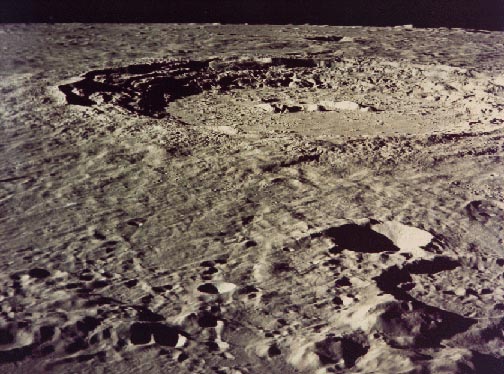
One of the more prominent craters on the Moon is named Copernicus. Copernicus is a large young crater visible with binoculars slightly northwest of the center of the Moon's Earth-facing hemisphere. Copernicus is distinguished by its size and by the many bright rays pointing out from it. Although Copernicus is relatively young for a lunar crater, it was formed nearly a billion years ago by a colossal impact. The center of Copernicus is about 93 kilometers across. The above picture was taken in 1972 by the last human mission to the moon: Apollo 17. The prospects for a return have been boosted recently with increased evidence of ice deposits near the lunar poles.