The Moon
The Moon is Earth’s only natural satellite—a rocky, cratered body about one‑quarter the diameter of Earth, orbiting at an average distance of approximately 384,400 km. It influences tides, stabilizes Earth’s axial tilt, and was formed about 4.5 billion years ago following a collision between Earth and a Mars-sized object.
Source: science.nasa.gov
APODs including "The Moon"
Jupiters Rings Revealed
16/09/1998
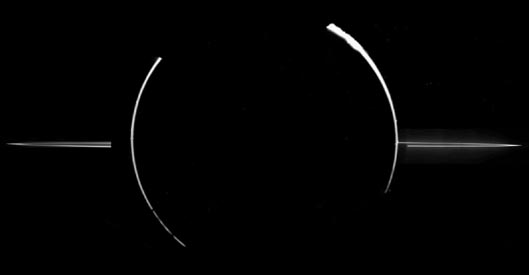
Why does Jupiter have rings? Jupiter's rings were discovered in 1979 by the passing Voyager 1 spacecraft, but their origin has always been a mystery. Recent data from the Galileo spacecraft currently orbiting Jupiter now confirms that these rings were created by meteoroid impacts on small nearby moons. As a small meteoroid strikes tiny Adrastea, for example, it will bore into the moon, vaporize, and explode dirt and dust off into a Jovian orbit. Pictured above is an eclipse of the Sun by Jupiter, as viewed from Galileo. Small dust particles high in Jupiter's atmosphere, as well as the dust particles that compose the rings, can be seen by reflected sunlight.