The Moon
The Moon is Earth’s only natural satellite—a rocky, cratered body about one‑quarter the diameter of Earth, orbiting at an average distance of approximately 384,400 km. It influences tides, stabilizes Earth’s axial tilt, and was formed about 4.5 billion years ago following a collision between Earth and a Mars-sized object.
Source: science.nasa.gov
APODs including "The Moon"
Magnetar In The Sky
02/10/1998
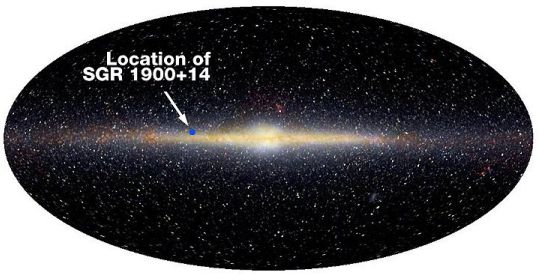
Indicated on this infrared image of the galactic center region is the position of SGR 1900+14 - the strongest known magnet in the galaxy. SGR 1900+14 is believed to be a city-sized, spinning, super-magnetic neutron star, or Magnetar. How strong is a Magnetar's magnetic field? The Earth's magnetic field which deflects compass needles is measured to be about 1 Gauss, the strongest fields sustainable in Earth-based laboratories are about 100,000 Gauss, yet the Magnetar's monster magnetic field is estimated to be 1,000,000,000,000,000 Gauss. A magnet this strong, located at about half the distance to the Moon would easily erase your credit cards and suck pens out of your pocket. From a distance of about 20,000 light-years, SGR 1900+14 recently generated a powerful flash of gamma-rays detected by many spacecraft. That blast of high-energy radiation is now known to have had a measurable effect on Earth's ionosphere. At the surface of the Magnetar, its powerful magnetic field is thought to buckle and shift the neutron star crust generating the intense gamma-ray flares.