The Moon
The Moon is Earth’s only natural satellite—a rocky, cratered body about one‑quarter the diameter of Earth, orbiting at an average distance of approximately 384,400 km. It influences tides, stabilizes Earth’s axial tilt, and was formed about 4.5 billion years ago following a collision between Earth and a Mars-sized object.
Source: science.nasa.gov
APODs including "The Moon"
Natural Saturn On The Cassini Cruise
05/11/1998
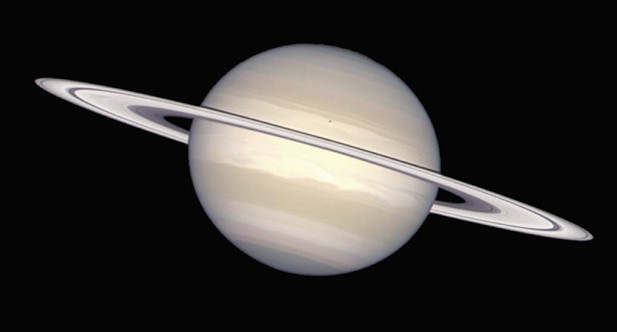
What you could see approaching Saturn aboard an interplanetary cruise ship would closely resemble this subtly shaded view of the gorgeous ringed gas giant. Processed by the Hubble Heritage project, the picture intentionally avoids overemphasizing color contrasts and presents a natural looking Saturn with cloud bands, storms, nearly edge-on rings, and the small round shadow of the moon Enceladus near the center of the planet's disk. Of course, seats were not available on the only ship currently enroute - the Cassini spacecraft, launched just over a year ago and scheduled to arrive at Saturn in the year 2004. After an extended cruise to a world 1,400 million kilometers from the Sun, Cassini will tour the Saturnian system, conducting a remote, robotic exploration with software and instruments designed by denizens of planet Earth.