The Moon
The Moon is Earth’s only natural satellite—a rocky, cratered body about one‑quarter the diameter of Earth, orbiting at an average distance of approximately 384,400 km. It influences tides, stabilizes Earth’s axial tilt, and was formed about 4.5 billion years ago following a collision between Earth and a Mars-sized object.
Source: science.nasa.gov
APODs including "The Moon"
The Full Moon
19/04/1999
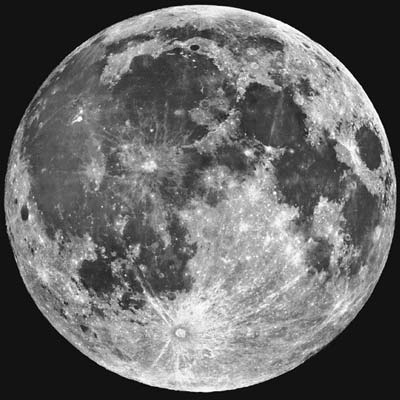
rth has one moon. A symbol in famous love songs, movies, poems, and folklore, many myths about the Moon date back to ancient history. In fact, the name Monday originates from Moon-day. The Moon glows by light it reflects from the Sun and is frequently the brightest object in the night sky. The Moon orbits the Earth about once a month (moon-th) from about 1 light second away. The above-pictured Full Moon occurs when the Moon is nearly opposite to the Sun in its orbit. The Moon's diameter is about 1/4 that of the Earth, and from the Earth's surface appears to have almost exactly the same angular size as the Sun. Recent evidence indicates that the Moon formed from a colossal impact on the Earth about 4.5 billions of years ago, and therefore has a similar composition to the Earth. Humans walked on the Moon for the first time in 1969.