The Moon
The Moon is Earth’s only natural satellite—a rocky, cratered body about one‑quarter the diameter of Earth, orbiting at an average distance of approximately 384,400 km. It influences tides, stabilizes Earth’s axial tilt, and was formed about 4.5 billion years ago following a collision between Earth and a Mars-sized object.
Source: science.nasa.gov
APODs including "The Moon"
Sun Block
18/08/1999
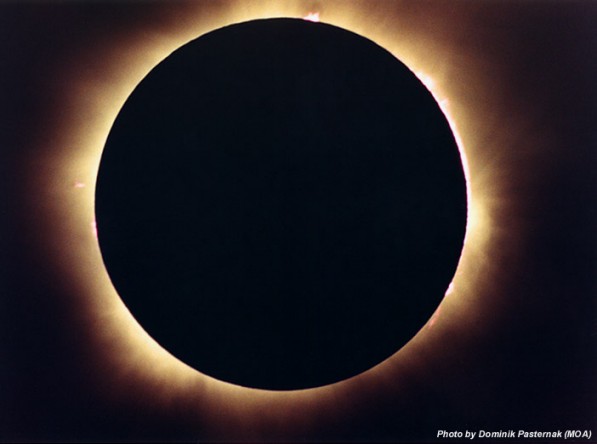
During a total solar eclipse, Earth's moon blocks the sun - almost exactly. While the sun is about 400 times wider than the moon, it is also about 400 times farther away and each appears to be half a degree or so in diameter. On August 11, this remarkable coincidence in the apparent size of two vastly different celestial bodies produced tantalizing solar spectacles for denizens of Europe and Asia. For example, prominences along the sun's limb peer around the moon's dark edge in this dramatic picture of totality recorded as the lunar shadow swept across Hungary. Subtle structures in the sun's inner corona are also visible streaming beyond the silhouetted moon. This total eclipse of the sun was the last to grace planet Earth's skies for this millennium. Although four partial eclipses will occur in the year 2000, the next total eclipse will not be until 2001 June 21.