The Moon
The Moon is Earth’s only natural satellite—a rocky, cratered body about one‑quarter the diameter of Earth, orbiting at an average distance of approximately 384,400 km. It influences tides, stabilizes Earth’s axial tilt, and was formed about 4.5 billion years ago following a collision between Earth and a Mars-sized object.
Source: science.nasa.gov
APODs including "The Moon"
Cassini Images The Moon
10/09/1999
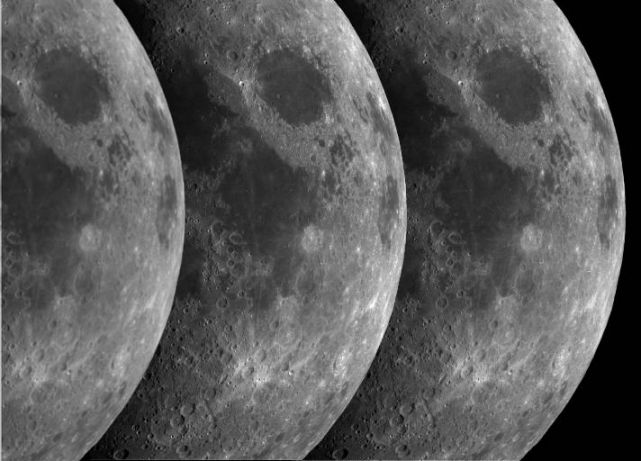
On August 18, the Cassini spacecraft flew by the Earth and Moon, then continued on its way to the outer solar system. Near its closest approach to the Moon, a distance of about 377,000 kilometers, controllers tested Cassini's imaging systems on this most familiar celestial body. This composite picture shows three resulting lunar images from the green, blue, and ultraviolet regions of the spectrum (left to right). Prominant in the upper right of each image is the dark, round Mare Crisium (Sea of Crises) at the eastern edge of the Moon's near side. With its cameras clearly functioning well, Cassini's next way-point will be Jupiter in December 2000. It is expected to arrive at its final destination, the Saturnian system, in 2004.