The Moon
The Moon is Earth’s only natural satellite—a rocky, cratered body about one‑quarter the diameter of Earth, orbiting at an average distance of approximately 384,400 km. It influences tides, stabilizes Earth’s axial tilt, and was formed about 4.5 billion years ago following a collision between Earth and a Mars-sized object.
Source: science.nasa.gov
APODs including "The Moon"
A Skygazer's Full Moon
13/01/2000
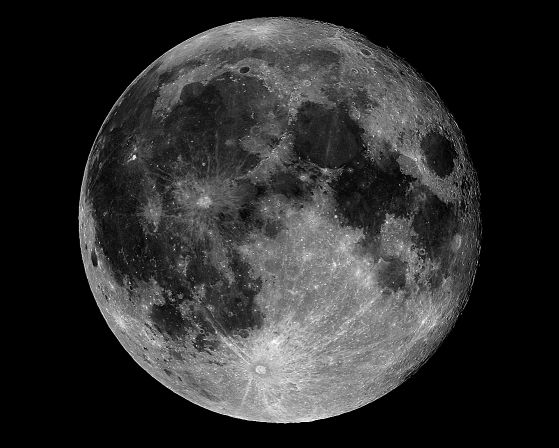
This dramatically sharp picture of the full moon was recorded on 22 December, 1999 by astroimager Rob Gendler. Big, beautiful, bright, and evocative, it was the last full moon of the Y1.9Ks, pleasing and inspiring even casual skygazers. December's moon was special for another reason, as the full phase occurred on the day of the winter solstice and within hours of lunar perigee. The first full moon of the year 2000 will bring a special treat as well, presenting denizens of planet Earth with a total lunar eclipse. On Thursday evening, January 20, the moon will encounter the dark edge of Earth's shadow at 10:01 PM Eastern Time with the total eclipse phase beginning at 11:05 PM and lasting for 77 minutes. This lunar eclipse will be visible from North and South America and Western Europe (total phase begins at 4:05 AM GMT January 21).