The Moon
The Moon is Earth’s only natural satellite—a rocky, cratered body about one‑quarter the diameter of Earth, orbiting at an average distance of approximately 384,400 km. It influences tides, stabilizes Earth’s axial tilt, and was formed about 4.5 billion years ago following a collision between Earth and a Mars-sized object.
Source: science.nasa.gov
APODs including "The Moon"
Blue Marble 2000
20/04/2000
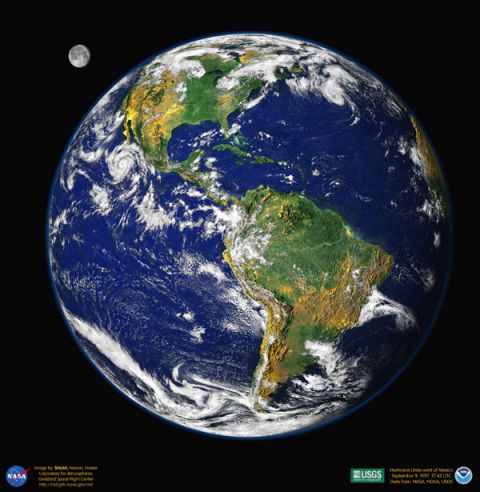
This newly released digital portrait of our planet is reminiscent of the Apollo-era pictures of the "big blue marble" Earth from space. To create it, researchers at Goddard Space Flight Center's Laboratory for Atmospheres combined data from a Geostationary Operational Environmental Satellite (GOES), the Sea-viewing Wide Field-of-view Sensor (SeaWiFS), and the Polar Orbiting Environmental Satellites (POES) with a USGS elevation model of Earth's topography. Stunningly detailed, the planet's western hemisphere is cast so that heavy vegetation is green and sparse vegetation is yellow, while the heights of mountains and depths of valleys have been exaggerated by 50 times to make vertical relief visible. Hurricane Linda is the dramatic storm off North America's west coast. And what about the Moon? The lunar image was reconstructed from GOES data and artistically rescaled for this visualization.