The Moon
The Moon is Earth’s only natural satellite—a rocky, cratered body about one‑quarter the diameter of Earth, orbiting at an average distance of approximately 384,400 km. It influences tides, stabilizes Earth’s axial tilt, and was formed about 4.5 billion years ago following a collision between Earth and a Mars-sized object.
Source: science.nasa.gov
APODs including "The Moon"
Jupiter's Moons Thebe, Amalthea, and Metis
08/05/2000
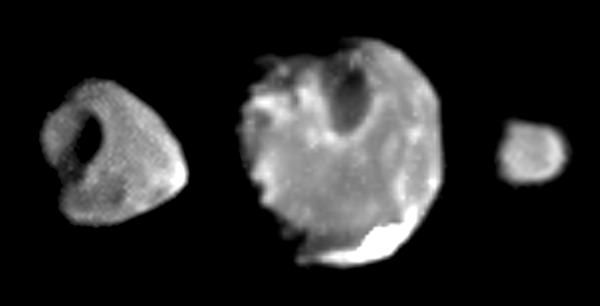
The robot spacecraft Galileo in orbit around Jupiter has recently photographed the inner moons of Jupiter in greater detail than ever before. These pictures of Thebe, Amalthea, and Metis are shown to scale, and reveal details as small as three kilometers across. Amalthea, by contrast, has a total length of about 200 kilometers. The moons are composed mostly of ice, are much smaller than Jupiter's more famous Galilean satellites (Io, Europa, Ganymede, and Callisto), and orbit between Io and Jupiter's rings. Thebe appears dominated by a huge impact crater 40 kilometers across. Astronomers are uncertain of the origin of the unusual white gash at the bottom of Amalthea.