The Moon
The Moon is Earth’s only natural satellite—a rocky, cratered body about one‑quarter the diameter of Earth, orbiting at an average distance of approximately 384,400 km. It influences tides, stabilizes Earth’s axial tilt, and was formed about 4.5 billion years ago following a collision between Earth and a Mars-sized object.
Source: science.nasa.gov
APODs including "The Moon"
A Perseid Aurora
21/08/2000
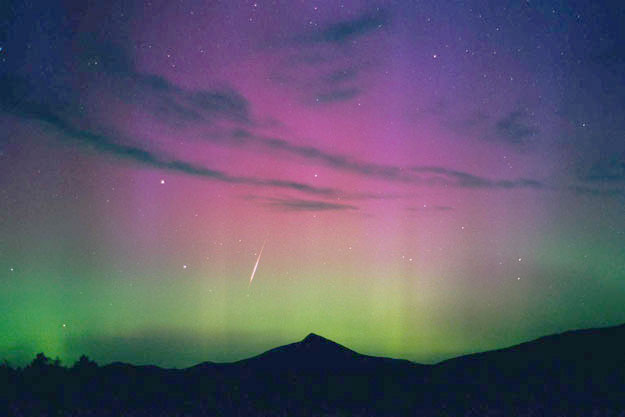
Just after the Moon set but before the Sun rose in the early morning hours of August 12, meteors pelted the Earth from the direction of the constellation Perseus, while ions pelted the Earth from the Sun. The meteors were expected as sub-sand grains long left behind by Comet Swift-Tuttle annually create the Perseids Meteor Shower. The aurorae were unexpected, however, as electrons, protons, and heavier ions raced out from a large Coronal Mass Ejection that had occurred just days before on the Sun. In the foreground is Hahn's Peak, an extinct volcano in Colorado, USA.