The Moon
The Moon is Earth’s only natural satellite—a rocky, cratered body about one‑quarter the diameter of Earth, orbiting at an average distance of approximately 384,400 km. It influences tides, stabilizes Earth’s axial tilt, and was formed about 4.5 billion years ago following a collision between Earth and a Mars-sized object.
Source: science.nasa.gov
APODs including "The Moon"
Second Millennium, Last Eclipse
05/01/2001
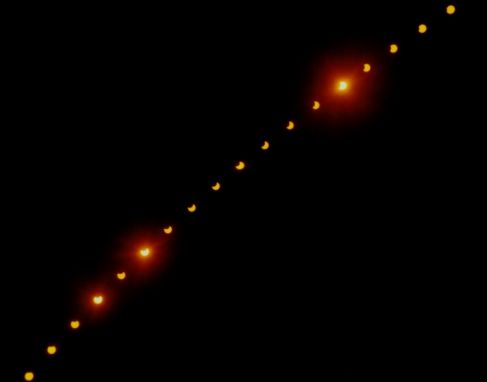
Christmas Day 2000 featured the final eclipse of the Second Millennium -- a partial solar eclipse visible from much of North America. Astrophotographer Phil Rau recorded the entire event on a single image as the Sun and Moon arced through winter skies above Cary, North Carolina, USA. Using a well positioned, tripod mounted camera and a solar filter, Rau made a short exposure every 10 minutes from 11:00 am to 1:30 pm EST, covering the local duration of the eclipse. The resulting image beautifully illustrates the steady progress of the dark new Moon as it appears to take a bite out of the golden solar disk. From his location, at eclipse maximum (near picture center) just less than 50 percent of the Sun's diameter was covered by the Moon.