The Moon
The Moon is Earth’s only natural satellite—a rocky, cratered body about one‑quarter the diameter of Earth, orbiting at an average distance of approximately 384,400 km. It influences tides, stabilizes Earth’s axial tilt, and was formed about 4.5 billion years ago following a collision between Earth and a Mars-sized object.
Source: science.nasa.gov
APODs including "The Moon"
Apollo 12: Stereo View Near Surveyor Crater
21/04/2001
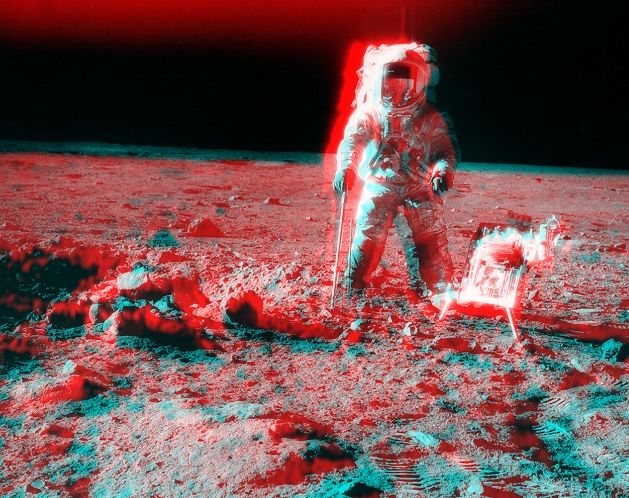
This weekend's stereo picture finds Apollo 12 astronaut Pete Conrad standing on the lunar surface near the southern rim of Surveyor Crater in November of 1969. With red/blue glasses you can gaze beyond the spacesuited Conrad across the magnificent desolation of the Moon's Ocean of Storms. Conrad stands next to large chunks of loose rock, debris from the small impact crater. A sampling scoop is in his right hand and a specially designed tool carrier rests by his left foot as he poses for the picture. His photographer, fellow astronaut Al Bean, captured two separate images (cataloged as AS12-49-7318 and AS12-49-7319) by doing something like a stereo "cha-cha" ... taking the first picture while resting his weight on his right foot and the second after shifting to his left. With the first tinted blue and second red, the pair of pictures were offset and combined to create a 3D anaglyph. Donning red/blue glasses allows the result to be viewed with stereo vision.