The Moon
The Moon is Earth’s only natural satellite—a rocky, cratered body about one‑quarter the diameter of Earth, orbiting at an average distance of approximately 384,400 km. It influences tides, stabilizes Earth’s axial tilt, and was formed about 4.5 billion years ago following a collision between Earth and a Mars-sized object.
Source: science.nasa.gov
APODs including "The Moon"
Bakasa Eclipse Sequence
06/07/2001
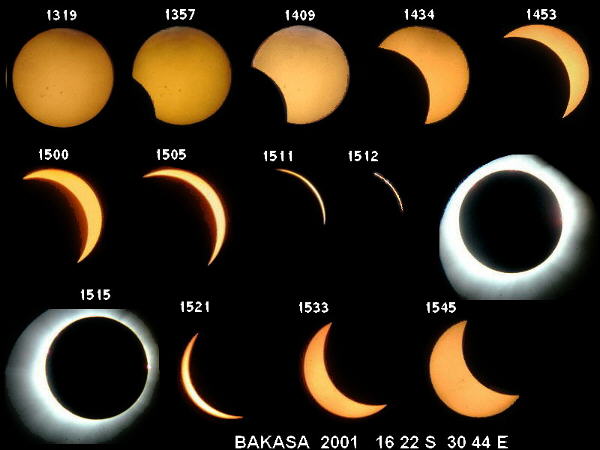
Starting at the upper left, this sequence of images follows the progress of the magnificent 21 June, 2001 solar eclipse in the clear skies over Bakasa, Zimbabwe. These pictures were recorded using a small reflecting telescope and digital camera with the approximate local time given above each frame. A simple pair of "eclipse spectacles" were mounted as a filter in front of the telescope mirror and removed during totality. In the early and late phases of this eclipse of the active Sun, sunspot groups can be seen lingering on the solar surface. During eclipse totality, pinkish prominences are visible at the solar limb along with details of the normally hidden solar corona. Seen from this location, the total eclipse phase lasted just under 3 1/2 minutes as the Moon's shadow rushed across northern Zimbabwe at nearly 5,000 kilometers per hour.