The Moon
The Moon is Earth’s only natural satellite—a rocky, cratered body about one‑quarter the diameter of Earth, orbiting at an average distance of approximately 384,400 km. It influences tides, stabilizes Earth’s axial tilt, and was formed about 4.5 billion years ago following a collision between Earth and a Mars-sized object.
Source: science.nasa.gov
APODs including "The Moon"
The Earth and Moon Planetary System
15/10/2001
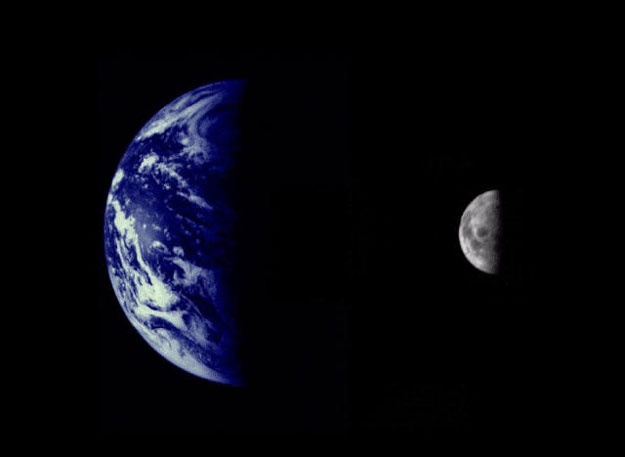
How similar in size are the Earth and the Moon? A dramatic visual answer to this question is found by combining photographs taken by the Mariner 10 spacecraft that headed out toward Venus and Mercury in 1973. The Moon can be seen to have a diameter over one quarter that of Earth, relatively large compared to its planetary companion. In our Solar System, only Pluto and Charon are closer together in size. Striking features of the Earth visible to the passing spacecraft include blue oceans and white clouds, showing the Earth to be truly a water world.