The Moon
The Moon is Earth’s only natural satellite—a rocky, cratered body about one‑quarter the diameter of Earth, orbiting at an average distance of approximately 384,400 km. It influences tides, stabilizes Earth’s axial tilt, and was formed about 4.5 billion years ago following a collision between Earth and a Mars-sized object.
Source: science.nasa.gov
APODs including "The Moon"
Saturn at the Lunar Limb
22/02/2002
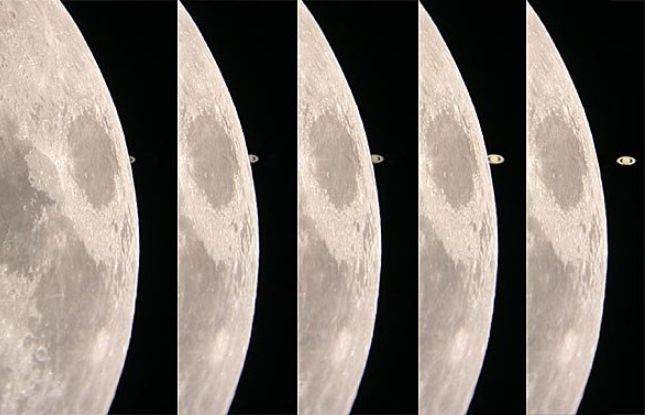
Gliding through the sky on Wednesday evening, February 20th, a first quarter Moon seemed to run over bright planet Saturn as viewed from much of North America. In this sharp sequence of telescopic digital images from the Powell Observatory near Louisburg, Kansas, USA, Saturn is seen reappearing from behind the bright lunar limb over a period of about 2 minutes. The ringed planet emerges above the dark, smooth lunar Mare Crisium (Sea of Crises). This lunar occultation was widely anticipated in part because the ringed planet and the brilliant Moon are both spectacular celestial sights. Now, European sky gazers will have their turn as the Moon occults the Solar System's largest planet, Jupiter in early morning hours on Saturday, February 23rd.