The Moon
The Moon is Earth’s only natural satellite—a rocky, cratered body about one‑quarter the diameter of Earth, orbiting at an average distance of approximately 384,400 km. It influences tides, stabilizes Earth’s axial tilt, and was formed about 4.5 billion years ago following a collision between Earth and a Mars-sized object.
Source: science.nasa.gov
APODs including "The Moon"
Saturn's Moon Tethys
19/05/2002
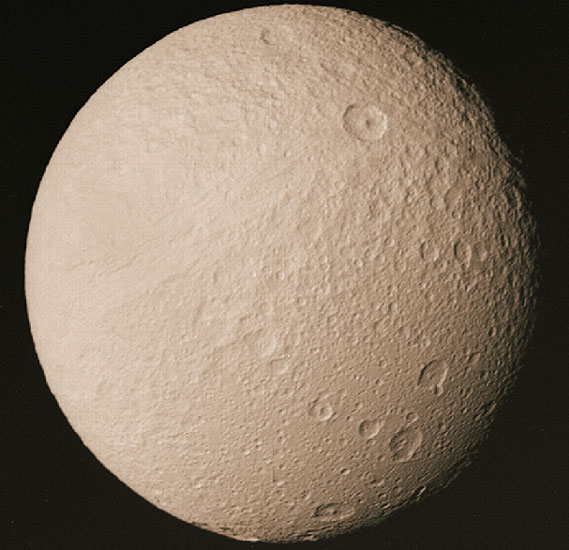
Tethys is one of the larger and closer moons of Saturn. It was visited by both Voyager spacecraft - Voyager 1 in November 1980 and by Voyager 2 in August 1981. Tethys is now known to be composed almost completely of water ice. Tethys shows a large impact crater that nearly circles the planet. That the impact that caused this crater did not disrupt the moon is taken as evidence that Tethys was not completely frozen in its past. Two smaller moons, Telesto and Calypso, orbit Saturn just ahead of and behind Tethys. Giovanni Cassini discovered Tethys in 1684. In 1997, NASA launched a spacecraft named Cassini to Saturn that will arrive in 2004.