The Moon
The Moon is Earth’s only natural satellite—a rocky, cratered body about one‑quarter the diameter of Earth, orbiting at an average distance of approximately 384,400 km. It influences tides, stabilizes Earth’s axial tilt, and was formed about 4.5 billion years ago following a collision between Earth and a Mars-sized object.
Source: science.nasa.gov
APODs including "The Moon"
Moon, Mars, Venus, and Spica
04/12/2002
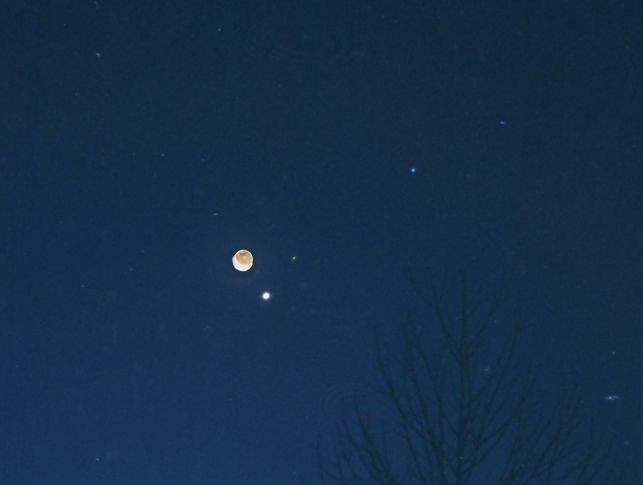
Gliding toward today's total eclipse of the Sun, the crescent Moon has been rising early, just before dawn. And as a prelude to its close solar alignment, the Moon also completed a lovely celestial triangle, closing with bright planets Mars and Venus on the morning of December 1. While the total solar eclipse can only be seen from a narrow corridor, skygazers around the globe could appreciate this lunar-planetary conjunction. This view is from near Nashville Tennessee, USA, and finds brilliant Venus at the lowest corner of the triangle with a much fainter Mars immediately to the right of the Moon. The Moon's sunlit crescent is overexposed, but details of the lunar night side are revealed by earthshine. Above and to the right of the trio is Spica, brightest star in the constellation Virgo.