The Moon
The Moon is Earth’s only natural satellite—a rocky, cratered body about one‑quarter the diameter of Earth, orbiting at an average distance of approximately 384,400 km. It influences tides, stabilizes Earth’s axial tilt, and was formed about 4.5 billion years ago following a collision between Earth and a Mars-sized object.
Source: science.nasa.gov
APODs including "The Moon"
Moon Slide Slim
15/05/2003
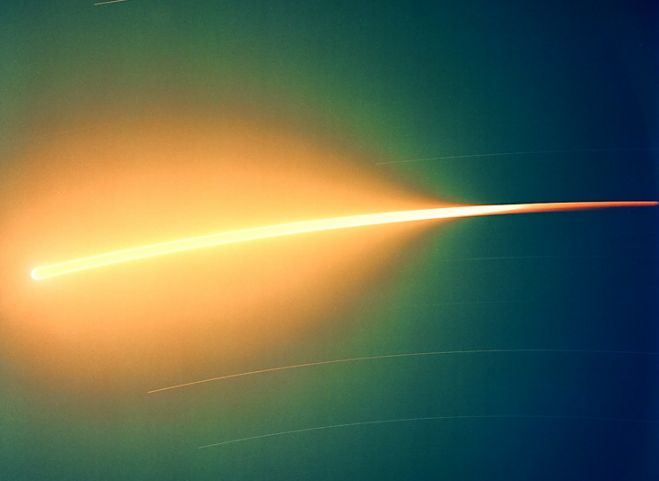
No special filters - or even a telescope - are required to enjoy a leisurely lunar eclipse. In fact, watched from all over the night side of planet Earth, these regular celestial performances have entertained many casual skygazers. Still, this eye-catching picture of a lunar eclipse may look unfamiliar. To make it, astrophotographer Doug Murray set his camera on a tripod and locked the shutter open during the total lunar eclipse of January 2000. The resulting image records the trail of the Moon sliding through the night, steadily progressing toward the total eclipse phase as seen from Florida, USA. Haunting red hues of diminished moonlight, common during the total phase of a lunar eclipse, are evident at the far right, along the slimmer portion of the trail. At least part of tonight's lunar eclipse will be visible in clear night skies over the Americas, Europe, and Africa. The eclipse should last over three hours from start to finish, with about 53 minutes of totality. Lunar eclipse: Times | Webcast | Photo Tips