The Moon
The Moon is Earth’s only natural satellite—a rocky, cratered body about one‑quarter the diameter of Earth, orbiting at an average distance of approximately 384,400 km. It influences tides, stabilizes Earth’s axial tilt, and was formed about 4.5 billion years ago following a collision between Earth and a Mars-sized object.
Source: science.nasa.gov
APODs including "The Moon"
Bright Lights, Dark City
18/08/2003
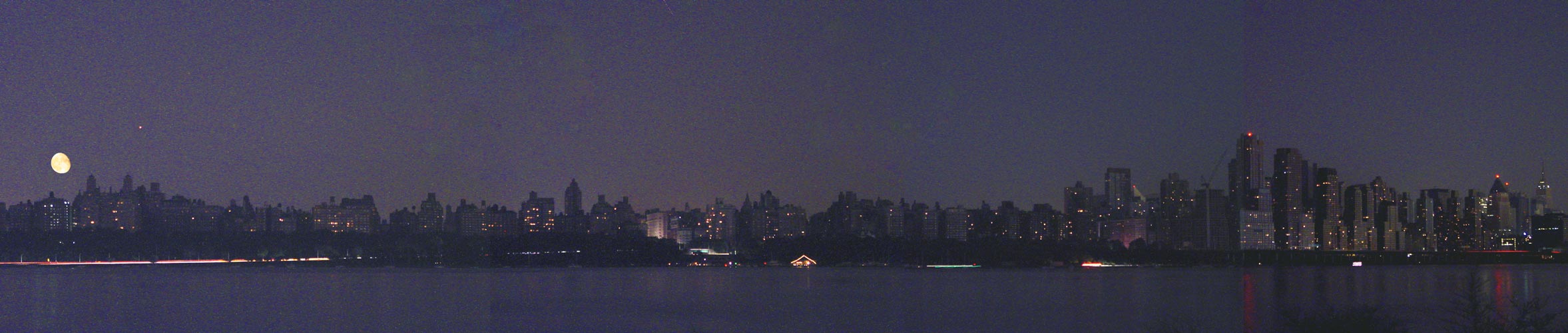
Last Thursday, millions of people had an unexpectedly good view of a dark night sky. Usually, the reflection of city lights off of local air impurities makes it hard for casual observers to see more than a handful of stars from a bright urban area. A large power outage in northeast North America, however, dimmed most city lights and brought unfamiliar celestial wonders to many who looked up. The unexpected starscape was perhaps a small perk in the face of hardships endured by many during the black out. Prominent in the above four-image digital montage are two of the few celestial wonders that can be seen even above the usual glare of city light pollution: the Moon and Mars. Both appear on the far left, with Mars to the upper right of the Moon. Scrolling right will show how eerily dark New York City appeared from across the Hudson River in New Jersey at about 10 pm on 2003 August 14. Visible lights are mostly attributable to cars, local power generators, flashlights, and candles.