The Moon
The Moon is Earth’s only natural satellite—a rocky, cratered body about one‑quarter the diameter of Earth, orbiting at an average distance of approximately 384,400 km. It influences tides, stabilizes Earth’s axial tilt, and was formed about 4.5 billion years ago following a collision between Earth and a Mars-sized object.
Source: science.nasa.gov
APODs including "The Moon"
Zubenelgenubi and Friends
14/05/2004
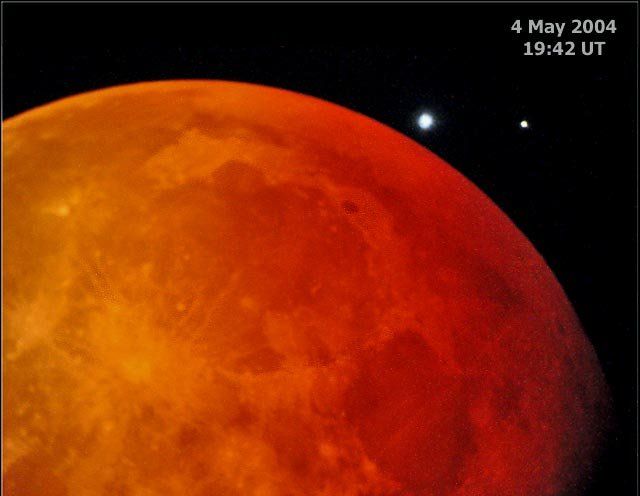
Moderately bright Zubenelgenubi is the star just off the upper right hand limb of an eclipsed Moon in this telescopic view from Port Elizabeth, South Africa. Actually the second brightest star in the constellation Libra, Zubenelgenubi is fun to pronounce (try zoo-BEN-al-je-NEW-bee ...) and rewarding to spot in the night sky as it has a fainter companion star, seen here on the far right. Astronomer Francois du Toit reports that both stars were visible to the unaided eye on the night of May 4th, during the Moon's total eclipse phase. Orbiting a common center of gravity once every 200,000 years or so, the two stars are both larger and hotter than the Sun. About 77 light years away they are separated from each other by over 730 light hours -- about 140 times Pluto's average distance from the Sun. Zubenelgenubi was once considered the southern claw of the nearby arachnologically correct constellation Scorpius. What star was the northern claw? Zubeneschamali, of course.