The Moon
The Moon is Earth’s only natural satellite—a rocky, cratered body about one‑quarter the diameter of Earth, orbiting at an average distance of approximately 384,400 km. It influences tides, stabilizes Earth’s axial tilt, and was formed about 4.5 billion years ago following a collision between Earth and a Mars-sized object.
Source: science.nasa.gov
APODs including "The Moon"
Apogee Moon, Perigee Moon
21/10/2004
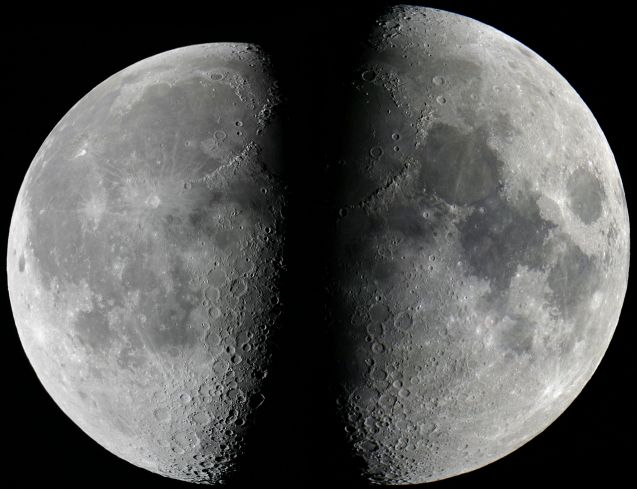
Why don't these pieces fit? This third quarter Moon (left) and first quarter Moon were both photographed during the last lunar cycle or lunation with the same telescope and camera. But, simply combining the pictures into one sharp, full surface view would clearly be a problem. In fact, on October 6th the Moon's third quarter phase happened to occur near lunar apogee, the farthest point in the Moon's orbit. On September 21st, the first quarter phase fell close to lunar perigee, the Moon's closest approach to planet Earth. Viewed two weeks apart, the resulting difference in apparent sizes would not be noticed by casual skygazers, but the simultaneous side by side comparison makes it hard to ignore. Skygazers will likely notice the Moon next week though, as it slides through Earth's shadow during October 27th's total lunar eclipse.