The Moon
The Moon is Earth’s only natural satellite—a rocky, cratered body about one‑quarter the diameter of Earth, orbiting at an average distance of approximately 384,400 km. It influences tides, stabilizes Earth’s axial tilt, and was formed about 4.5 billion years ago following a collision between Earth and a Mars-sized object.
Source: science.nasa.gov
APODs including "The Moon"
Moon Over Shiraz
13/11/2004
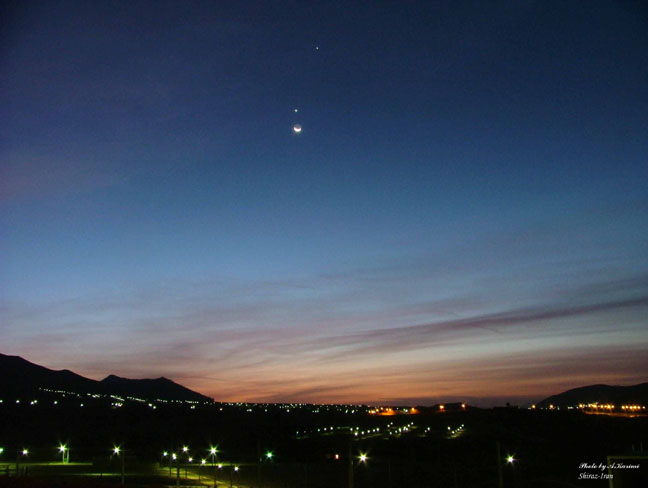
rly morning risers around the world have enjoyed the sight of bright planets in this week's predawn skies - further enhanced by the celestial spectacle of the waning crescent Moon. From some locations the Moon was seen to pass in front of Jupiter or Venus, a lunar occultation. Recorded near sunrise on November 10th from Shiraz, Iran, this eastern horizon view finds Jupiter (top) and a brilliant Venus in line with the Moon, a lovely conjunction of the three brightest objects in the night sky. Although the Moon has now fallen out of the early morning scene, Venus and Jupiter (along with a much fainter Mars) still precede the rising Sun above the eastern horizon.