The Moon
The Moon is Earth’s only natural satellite—a rocky, cratered body about one‑quarter the diameter of Earth, orbiting at an average distance of approximately 384,400 km. It influences tides, stabilizes Earth’s axial tilt, and was formed about 4.5 billion years ago following a collision between Earth and a Mars-sized object.
Source: science.nasa.gov
APODs including "The Moon"
Jupiter and the Moon's Shadowed Horizon
09/12/2004
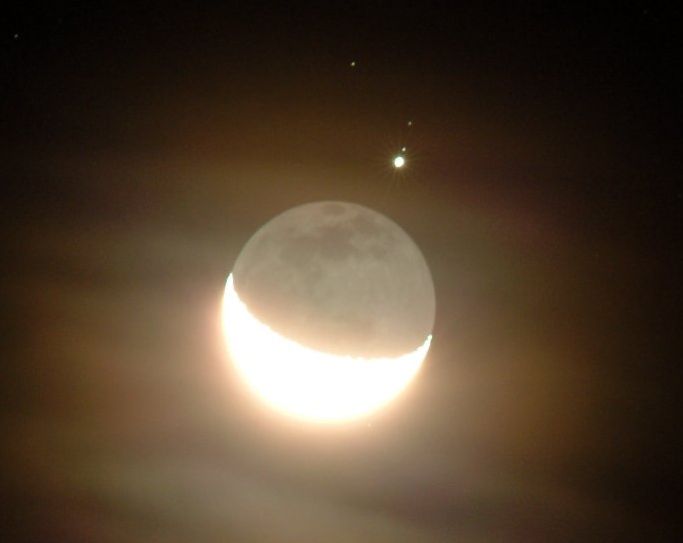
rly Tuesday morning, December 7th, June Croft thought the southeastern sky above Atmore, Alabama, USA was beautiful. Watching the Moon rise through gossamer clouds, she noted, " ... the crescent Moon looked like it was held in the sky by a star just off its shadowed horizon." What was that star? Bright Jupiter of course, and some watched as the Moon actually occulted or passed in front of the Solar System's reigning gas giant planet. For astronomer Jimmy Westlake in Colorado, Jupiter was already hidden at moonrise that morning, but later he was able to record this lovely image, not unlike the view that inspired Croft. Seen through gossamer clouds, Jupiter along with large Jovian satellites Ganymede and Callisto (bottom to top) has emerged from behind the crescent Moon's shadowed horizon. News: The answer to Lewin's Challenge APOD can be found here.