The Moon
The Moon is Earth’s only natural satellite—a rocky, cratered body about one‑quarter the diameter of Earth, orbiting at an average distance of approximately 384,400 km. It influences tides, stabilizes Earth’s axial tilt, and was formed about 4.5 billion years ago following a collision between Earth and a Mars-sized object.
Source: science.nasa.gov
APODs including "The Moon"
SMART-1: Pythagoras Crater
03/02/2005
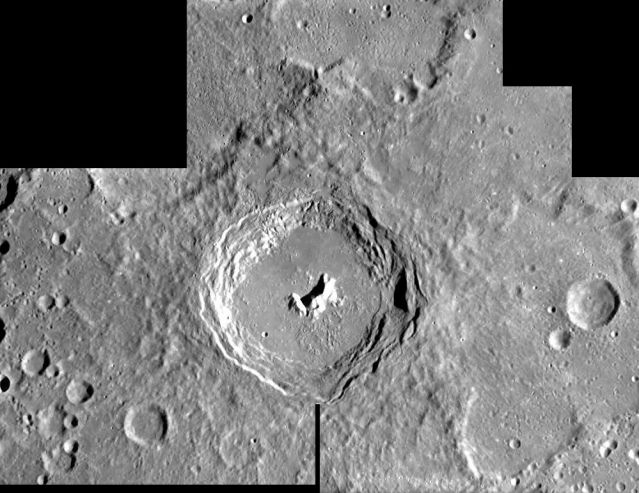
Stark shadows show off the central peaks and terraced walls of 120 kilometer wide Pythagoras Crater in this mosaic of images from ESA's SMART-1 spacecraft. Characteristic of large, complex impact craters on the Moon, the central uplift was produced by a rebound of the suddenly molten lunar crust during the violent impact event. Propelled by an efficient ion engine, the innovative SMART-1 spacecraft entered lunar orbit in November last year after a leisurely 13 month journey from planet Earth. Now viewing the lunar surface from an altitude of 1,000 to 5,000 kilometers SMART-1 (Small Missions for Advanced Research in Technology -1) will spiral closer to the Moon later this month.