The Moon
The Moon is Earth’s only natural satellite—a rocky, cratered body about one‑quarter the diameter of Earth, orbiting at an average distance of approximately 384,400 km. It influences tides, stabilizes Earth’s axial tilt, and was formed about 4.5 billion years ago following a collision between Earth and a Mars-sized object.
Source: science.nasa.gov
APODs including "The Moon"
Tycho and Copernicus: Lunar Ray Craters
05/03/2005
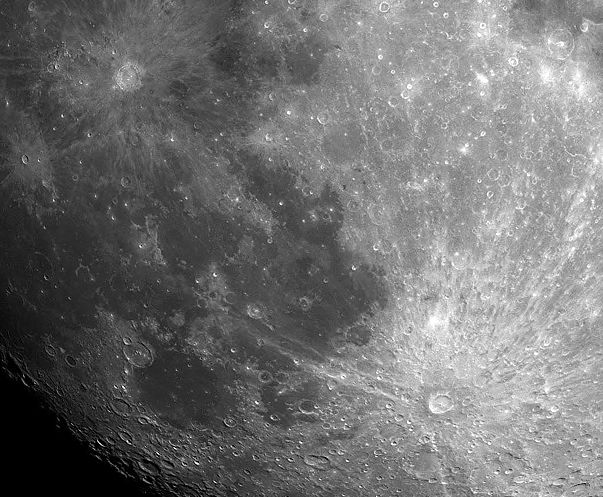
Dazzling in binoculars or a small telescope, the Moon is pocked with impact craters. During partial lunar phases, the craters along the terminator are cast in dramatic relief by strong shadows. But when the Moon is full some craters seem to sprout systems of bright radial lines or rays. This detailed close-up of the full Moon features two prominent ray craters, Copernicus (upper left) and Tycho (lower right), each with extensive ray systems of light colored debris blasted out by the crater-forming impacts. In general, ray craters are relatively young as their rays overlay the lunar terrain. In fact, at 85 kilometers wide, Tycho, with its far reaching rays, is the youngest large crater on the nearside. Crater Copernicus, surrounded by dark mare which contrast nicely with its bright rays, is 93 kilometers in diameter.