The Moon
The Moon is Earth’s only natural satellite—a rocky, cratered body about one‑quarter the diameter of Earth, orbiting at an average distance of approximately 384,400 km. It influences tides, stabilizes Earth’s axial tilt, and was formed about 4.5 billion years ago following a collision between Earth and a Mars-sized object.
Source: science.nasa.gov
APODs including "The Moon"
April's Moon and the Pleiades
14/04/2005
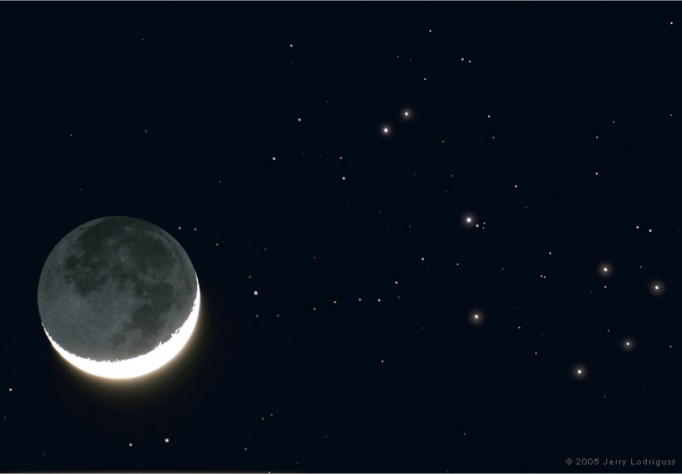
After parting with the Sun late last week, April's moon graced the early evening sky. Its slender, three-day-old crescent shares this lovely telescopic skyview with the nearby Pleiades star cluster. Here, the Moon's sunlit crescent is overexposed while the lunar terminator, or boundary between lunar night and day, is jagged with craters and mountains. Lunar surface features can also be seen in the dim lunar night illuminated by earthshine - light from sunlit planet Earth. The sister stars of the Pleiades are grouped at the right, but their alluring blue reflection nebulae, usually highlighted in telescopic images of the cluster, are washed-out in the much brighter moonlight.