The Moon
The Moon is Earth’s only natural satellite—a rocky, cratered body about one‑quarter the diameter of Earth, orbiting at an average distance of approximately 384,400 km. It influences tides, stabilizes Earth’s axial tilt, and was formed about 4.5 billion years ago following a collision between Earth and a Mars-sized object.
Source: science.nasa.gov
APODs including "The Moon"
Fresh Tiger Stripes on Saturn's Enceladus
06/09/2005
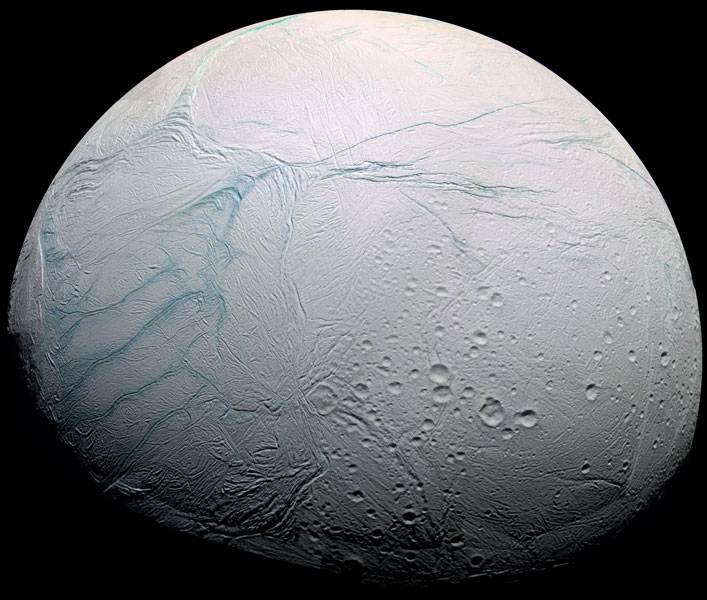
The tiger stripes on Saturn's moon Enceladus might be active. Even today, they may be spewing ice from the moon's icy interior into space, creating a cloud of fine ice particles over the moon's South Pole and creating Saturn's mysterious E-ring. Recent evidence for this has come from the robot Cassini spacecraft now orbiting Saturn. Cassini detected a marked increase in particle collisions during its July flyby only 270 kilometers over a South Polar region of Enceladus. Pictured above, a high resolution image of Enceladus is shown from the close flyby. The unusual surface features dubbed tiger stripes are visible on the left in false-color blue. Why Enceladus is active remains a mystery, as the neighboring moon Mimas, approximately the same size, appears quite dead.