The Moon
The Moon is Earth’s only natural satellite—a rocky, cratered body about one‑quarter the diameter of Earth, orbiting at an average distance of approximately 384,400 km. It influences tides, stabilizes Earth’s axial tilt, and was formed about 4.5 billion years ago following a collision between Earth and a Mars-sized object.
Source: science.nasa.gov
APODs including "The Moon"
Moon River
09/09/2005
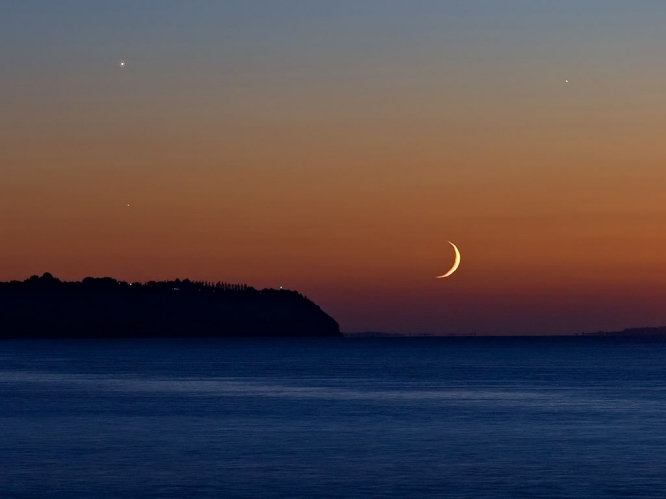
Shortly after sunset on September 6th, sky gazers around the world were treated to a lovely crescent Moon in western skies -- joined by bright planets Venus and Jupiter. In this colorful telephoto view from near Quebec City, Canada the Moon is nestled just above the wide St. Lawrence River. Lights on the horizon are along the river's southern shore. Also known as the evening star, Venus is at the upper left and Jupiter at the upper right, while another prominent celestial beacon, Spica, can be seen shining through the twilight below Venus. Spica, actually a very close pair of hot blue stars some 260 light-years away, is the brightest star in the constellation Virgo.