The Moon
The Moon is Earth’s only natural satellite—a rocky, cratered body about one‑quarter the diameter of Earth, orbiting at an average distance of approximately 384,400 km. It influences tides, stabilizes Earth’s axial tilt, and was formed about 4.5 billion years ago following a collision between Earth and a Mars-sized object.
Source: science.nasa.gov
APODs including "The Moon"
On the Possibility of Ascending to Mars
19/10/2005
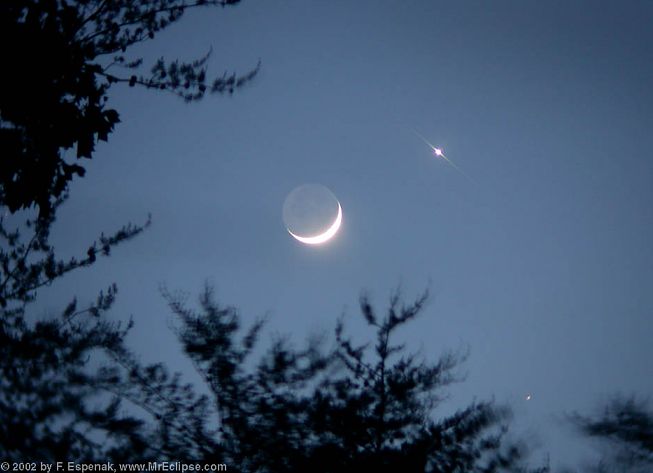
On another October 19, in 1899, a 17 year-old Robert Goddard climbed a cherry tree on a beautiful autumn afternoon in Worcester, Massachusetts. Inspired by H.G. Wells' War of the Worlds and gazing out across a meadow, young Goddard imagined it would be wonderful to make a device that had the possibility of ascending to Mars. Forever more he felt his life had a purpose and in the following years his diary entries record October 19th as "Anniversary Day", the anniversary of his ascent into the cherry tree. By 1926 he had designed, built, and flown the world's first liquid fuel rocket. Mars is just visible through the trees at the lower right in this dramatic sky view that also features the Moon and Venus -- all visited by liquid fuel rockets constructed on principles developed by Goddard.