The Moon
The Moon is Earth’s only natural satellite—a rocky, cratered body about one‑quarter the diameter of Earth, orbiting at an average distance of approximately 384,400 km. It influences tides, stabilizes Earth’s axial tilt, and was formed about 4.5 billion years ago following a collision between Earth and a Mars-sized object.
Source: science.nasa.gov
APODs including "The Moon"
Epimetheus and Janus: Interchangeable Moons of Saturn
02/11/2005
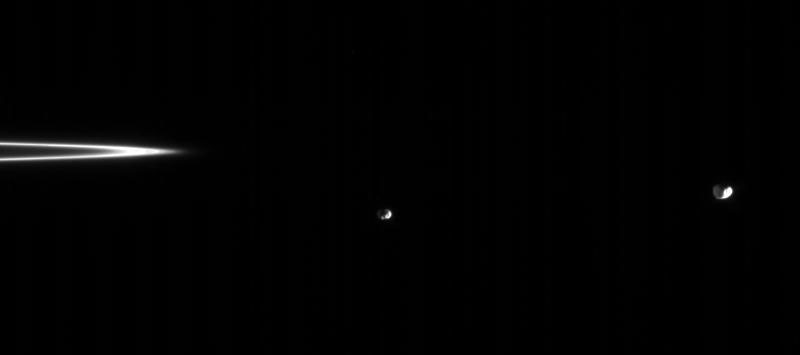
These two moons change places. Epimetheus and Janus, two small moons of Saturn, actually switch positions as they orbit their home planet. The orbital radii of the moons are strangely separated by less than the radii of the moons themselves: about 50 kilometers. One moon orbits Saturn well ahead of the other, at first. As the two moons gravitationally attract, they approach each other and, every few years, actually pass and trade orbits. This strange dance creates speculation that Epimetheus and Janus were once joined and later split from each other. Pictured above, the two moons were photographed rounding their orbits just outside of Saturn's F ring. The above image was taken in early September by the robot Cassini spacecraft, also orbiting Saturn.