The Moon
The Moon is Earth’s only natural satellite—a rocky, cratered body about one‑quarter the diameter of Earth, orbiting at an average distance of approximately 384,400 km. It influences tides, stabilizes Earth’s axial tilt, and was formed about 4.5 billion years ago following a collision between Earth and a Mars-sized object.
Source: science.nasa.gov
APODs including "The Moon"
Moon Over Antarctica
25/11/2005
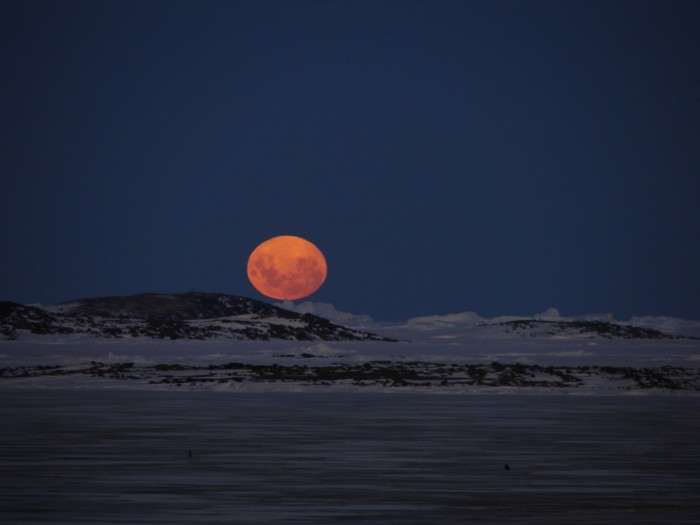
Last week, the nearly Full Moon set along the northern horizon - as seen from Davis Station, Antarctica. The squashed orange pumpkin shape just silhouettes the peak of a distant iceberg in this stunning view. The Moon's apparently squashed shape is due to atmospheric bending of light or refraction - an effect which is more severe closer to the horizon. Skimming low along the stark features of the frozen landscape, the Moon's lower edge appears noticeably more distorted than the upper limb. Along with about 70 others present at Davis Station, Dr. Jim Behrens had a chance to enjoy the view while studying the ongoing detachment of a large iceberg known as "Loose Tooth".