The Moon
The Moon is Earth’s only natural satellite—a rocky, cratered body about one‑quarter the diameter of Earth, orbiting at an average distance of approximately 384,400 km. It influences tides, stabilizes Earth’s axial tilt, and was formed about 4.5 billion years ago following a collision between Earth and a Mars-sized object.
Source: science.nasa.gov
APODs including "The Moon"
Vanishing Umbra
08/04/2006
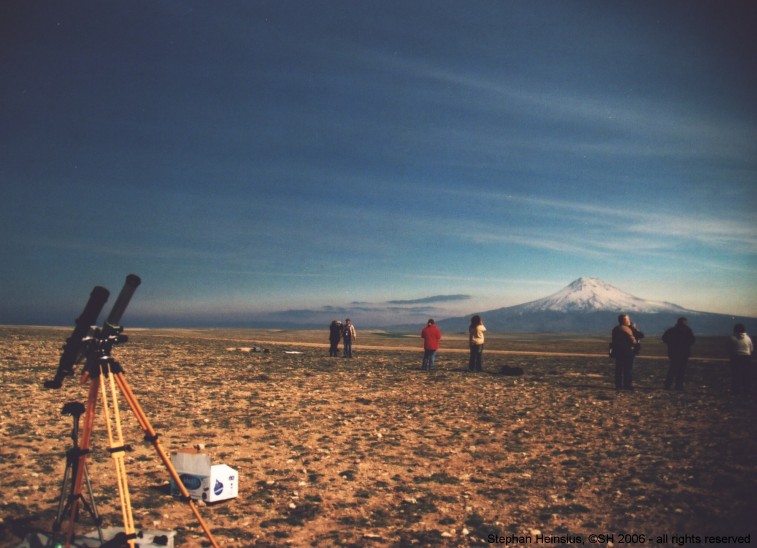
During the March 29 total solar eclipse, the Moon's dark central shadow or umbra is vanishing beyond the horizon in this dramatic view of the landscape a few kilometers southeast of Incesu, Anatolia, Turkey. The large, snow covered mountain in the distance is 3,250 meter high volcano Hasan Dag. The foreground is growing brighter as eclipse watchers are just beginning to see rays of sunlight peek around the lunar limb, while the mountains on the horizon, left of Hasan Dag, are still completely shadowed by the Moon. For the watchers along this part of the shadow track, the total phase of the eclipse lasted less than 4 minutes as the umbra raced over them at more than 3,000 kilometers per hour.