The Moon
The Moon is Earth’s only natural satellite—a rocky, cratered body about one‑quarter the diameter of Earth, orbiting at an average distance of approximately 384,400 km. It influences tides, stabilizes Earth’s axial tilt, and was formed about 4.5 billion years ago following a collision between Earth and a Mars-sized object.
Source: science.nasa.gov
APODs including "The Moon"
Moon Over Haleakala
10/06/2006
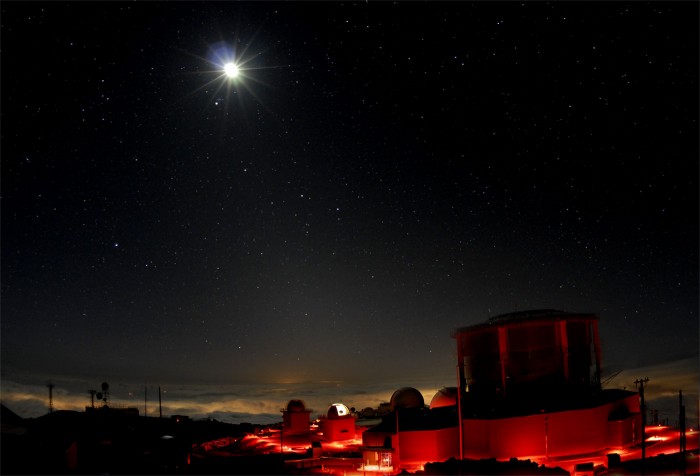
A waxing crescent Moon shines over the caldera of dormant volcano Haleakala and observatory domes in this dramatic view from above the clouds. Looking west from Maui, Hawaii on May 31st, the scene also records the lights of Honolulu on the horizon. Near the strongly overexposed crescent is bright planet Saturn, but included in the skyscape are planet Mars and the Gemini stars Castor and Pollux. Of course, skywatchers also found star cluster M44, The Beehive Cluster, in this early evening sky, wedged between Saturn and the Moon. In fact, as it closes with Saturn, Mars will pass in front of the Beehive on June 15, so just keep looking west. (Can't find all the players? Click here for help.)