The Moon
The Moon is Earth’s only natural satellite—a rocky, cratered body about one‑quarter the diameter of Earth, orbiting at an average distance of approximately 384,400 km. It influences tides, stabilizes Earth’s axial tilt, and was formed about 4.5 billion years ago following a collision between Earth and a Mars-sized object.
Source: science.nasa.gov
APODs including "The Moon"
Colorful Moon Mosaic
07/09/2006
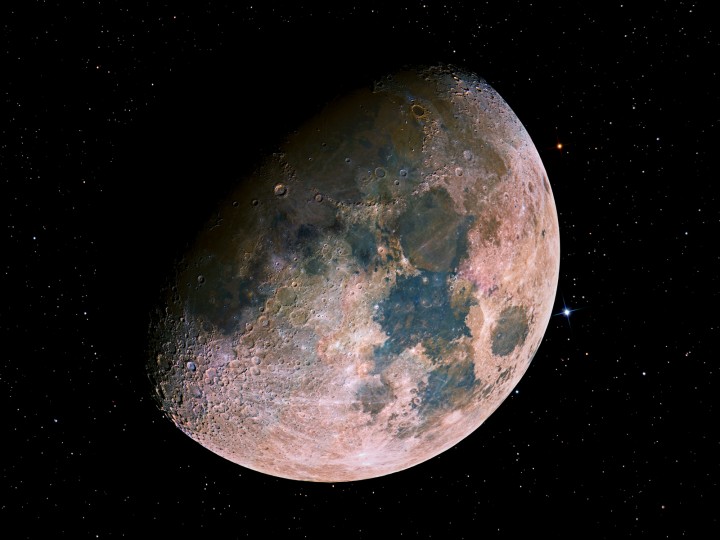
No single exposure can easily capture faint stars along with the subtle colors of the Moon. But this dramatic composite view highlights both. The mosaic digitally stitches together fifteen carefully exposed high resolution images of a bright, gibbous Moon and a representative background star field. The fascinating color differences along the lunar surface are real, though highly exaggerated, corresponding to regions with different chemical compositions. And while these color differences are not visible to the eye even with a telescope, moon watchers can still see a dramatic lunar presentation tonight. A partial eclipse of the Moon will be visible from Europe, Africa, Asia, and Australia.