The Moon
The Moon is Earth’s only natural satellite—a rocky, cratered body about one‑quarter the diameter of Earth, orbiting at an average distance of approximately 384,400 km. It influences tides, stabilizes Earth’s axial tilt, and was formed about 4.5 billion years ago following a collision between Earth and a Mars-sized object.
Source: science.nasa.gov
APODs including "The Moon"
Crescent Venus and Moon
30/10/2006
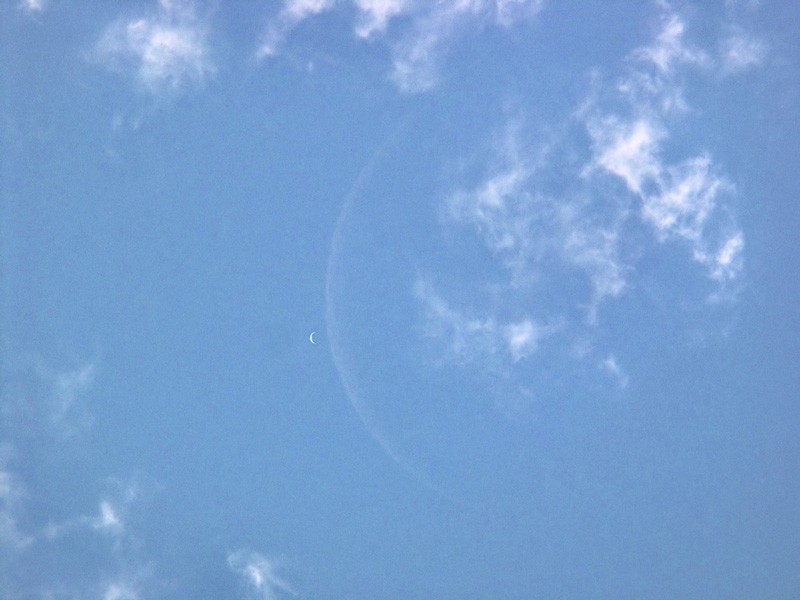
There's something behind these clouds. Those faint graceful arcs, upon inspection, are actually far, far in the distance. They are the Earth's Moon and the planet Venus. Both the Moon and Venus are bright enough to be seen during the day, and both are quite capable of showing a crescent phase. To see Venus, which appears quite small, in a crescent phase requires binoculars or a telescope. In the above dramatic daytime image taken from Budapest, Hungary, the Moon and Venus shared a similar crescent phase a few minutes before the Moon eclipsed the larger but more distant world. About an hour later, Venus reappeared.