The Moon
The Moon is Earth’s only natural satellite—a rocky, cratered body about one‑quarter the diameter of Earth, orbiting at an average distance of approximately 384,400 km. It influences tides, stabilizes Earth’s axial tilt, and was formed about 4.5 billion years ago following a collision between Earth and a Mars-sized object.
Source: science.nasa.gov
APODs including "The Moon"
Leonids and Leica
18/11/2006
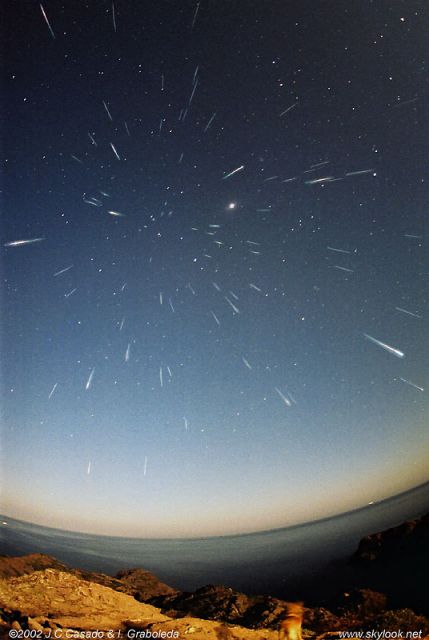
This lovely view from northern Spain at Cape Creus on the easternmost point of the Iberian peninsula, looks out across the Mediteranean and up into the stream of the 2002 Leonid meteor shower. The picture is a composite of thirty separate one minute exposures taken through a fisheye lens. Over 70 leonid meteors are visible, some seen nearly head on. Bright Jupiter is positioned just to the right of the shower's radiant in Leo. Perched on the moonlit rocks at the bottom right, Leica, the photographers' dog, seems to be watching the on going celestial display and adds a surreal visual element to the scene. The 2006 Leonid meteor shower will be much less intense than in 2002, but will be near its predicted peak this weekend. Sky watchers will have their best view under dark skies in early morning hours with Leo rising above the eastern horizon.