The Moon
The Moon is Earth’s only natural satellite—a rocky, cratered body about one‑quarter the diameter of Earth, orbiting at an average distance of approximately 384,400 km. It influences tides, stabilizes Earth’s axial tilt, and was formed about 4.5 billion years ago following a collision between Earth and a Mars-sized object.
Source: science.nasa.gov
APODs including "The Moon"
Eclipsed Moon and Stars
08/03/2007
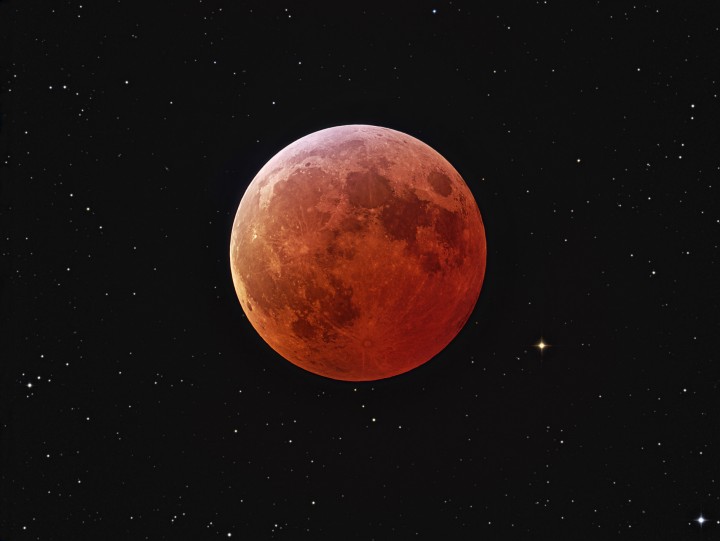
This dramatic image features a dark red Moon during a total lunar eclipse -- celestial shadow play enjoyed by many denizens of planet Earth last Saturday. Recorded near Wildon, Austria, the picture is a composite of two exposures; a relatively short exposure to feature the lunar surface and a longer exposure to capture background stars in the constellation Leo. Completely immersed in Earth's cone-shaped shadow during the total eclipse phase, the lunar surface is still illuminated by sunlight, reddened and refracted into the dark shadow region by a dusty atmosphere. As a result, familiar details of the Moon's nearside are easy to pick out, including the smooth lunar mare and the large ray crater Tycho. In this telescopic view, the background stars are faint and most would be invisible to the naked eye.