The Moon
The Moon is Earth’s only natural satellite—a rocky, cratered body about one‑quarter the diameter of Earth, orbiting at an average distance of approximately 384,400 km. It influences tides, stabilizes Earth’s axial tilt, and was formed about 4.5 billion years ago following a collision between Earth and a Mars-sized object.
Source: science.nasa.gov
APODs including "The Moon"
Eclipse and Ecliptic
09/03/2007
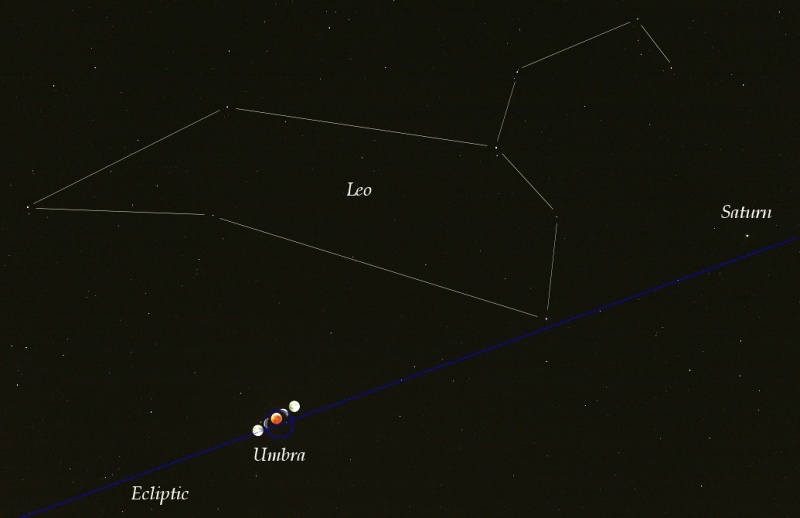
When a Full Moon lies near the ecliptic there can be a lunar eclipse. That cosmic alignment is well illustrated in this composite of eclipse images recorded last Saturday near Paris, France. The projection of the ecliptic plane, the plane of planet Earth's orbit around the Sun, is traced by the long blue line running diagonally through the picture. At a small angle to the ecliptic, along the Moon's orbit, are a series of images from the eclipse itself following the Moon as it moves (down and left) through Earth's shadow. A small blue circle centered on the ecliptic outlines the extent of the dark region of the shadow or umbra. Above, the principal stars of Leo are highlighted, while at the far right lies another celestial wanderer that stays close to the ecliptic - Saturn.