The Moon
The Moon is Earth’s only natural satellite—a rocky, cratered body about one‑quarter the diameter of Earth, orbiting at an average distance of approximately 384,400 km. It influences tides, stabilizes Earth’s axial tilt, and was formed about 4.5 billion years ago following a collision between Earth and a Mars-sized object.
Source: science.nasa.gov
APODs including "The Moon"
3D Full Moon
02/06/2007
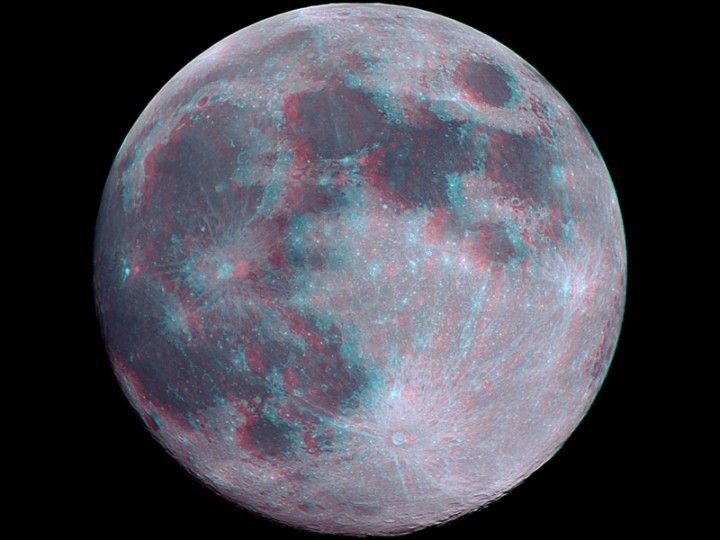
Get out your red/blue glasses and check out this satisfying stereo anaglyph of the Full Moon. A corresponding stereo image pair, intended for cross-eyed viewing, is also available through this link. Regardless of your preferred technique for stereo viewing, the 3D effect comes from combining pictures of the same scene taken at different angles -- mimicking the slightly different perspective of each eye. Perhaps surprisingly for Earthdwellers, getting two pictures of the Full Moon from different angles only requires a little patience. In this case, photographer Laurent Laveder used pictures taken months apart, one in November 2006 and one in January 2007. He relied on the Moon's continuous libration or wobble as it orbits to produce two shifted images of a Full Moon.