The Moon
The Moon is Earth’s only natural satellite—a rocky, cratered body about one‑quarter the diameter of Earth, orbiting at an average distance of approximately 384,400 km. It influences tides, stabilizes Earth’s axial tilt, and was formed about 4.5 billion years ago following a collision between Earth and a Mars-sized object.
Source: science.nasa.gov
APODs including "The Moon"
Raining Perseids
12/08/2007
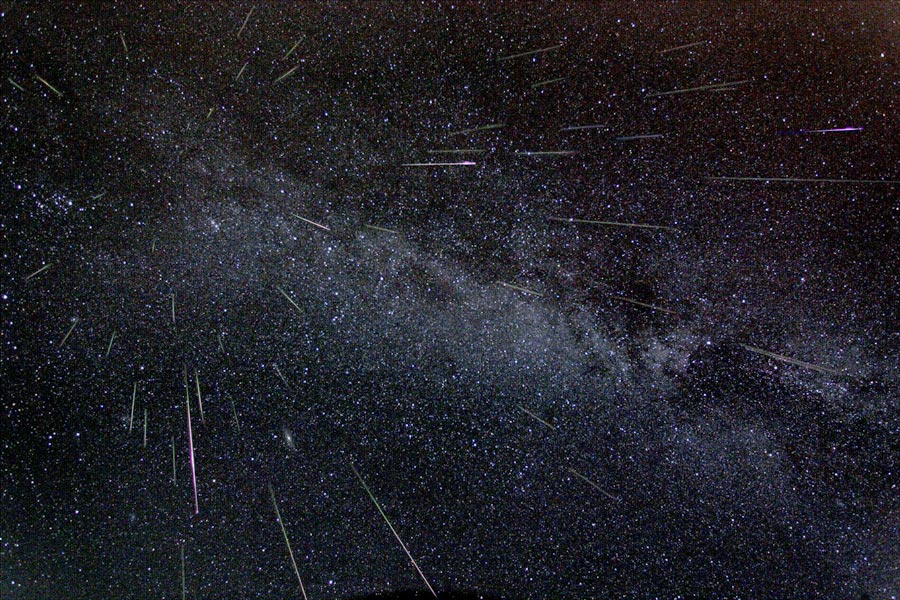
Tonight is a good night to see meteors. Comet dust will rain down on planet Earth, streaking through dark skies in the annual Perseid meteor shower. While enjoying the anticipated space weather, astronomer Fred Bruenjes recorded a series of many 30 second long exposures spanning about six hours on the night of 2004 August 11/12 using a wide angle lens. Combining those frames which captured meteor flashes, he produced this dramatic view of the Perseids of summer. Although the comet dust particles are traveling parallel to each other, the resulting shower meteors clearly seem to radiate from a single point on the sky in the eponymous constellation Perseus. The radiant effect is due to perspective, as the parallel tracks appear to converge at a distance. Bruenjes notes that there are 51 Perseid meteors in the composite image, including one seen nearly head-on. This year, the Perseids Meteor Shower is expected to peak after midnight tonight, in the moonless early morning hours of August 12.