The Moon
The Moon is Earth’s only natural satellite—a rocky, cratered body about one‑quarter the diameter of Earth, orbiting at an average distance of approximately 384,400 km. It influences tides, stabilizes Earth’s axial tilt, and was formed about 4.5 billion years ago following a collision between Earth and a Mars-sized object.
Source: science.nasa.gov
APODs including "The Moon"
Iapetus in Black and White
14/09/2007
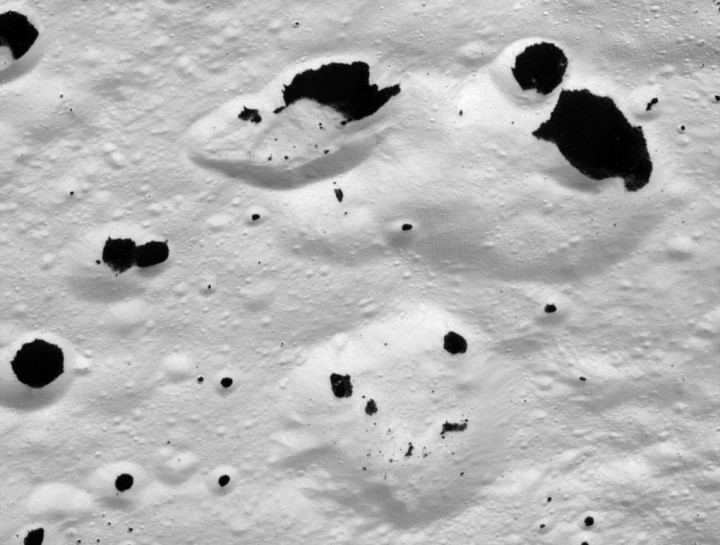
Iapetus, Saturn's third largest moon, is a candidate for the strangest moon of Saturn. Tidally locked in its orbit around the ringed gas giant, Iapetus is sometimes called the yin-yang moon because its leading hemisphere is very dark, reflecting about 5 percent of the Sun's light, while its trailing hemisphere is almost as bright as snow. This recent Cassini spacecraft flyby image is one of the closest views ever. It spans about 35 kilometers across a cratered transition zone between bright and dark terrain. Iapetus itself has a density close to that of water ice, but the detailed reflective properties of the dark material suggest an organic composition. Honoring the moon's discoverer, the dark terrain is called Cassini Regio.