The Moon
The Moon is Earth’s only natural satellite—a rocky, cratered body about one‑quarter the diameter of Earth, orbiting at an average distance of approximately 384,400 km. It influences tides, stabilizes Earth’s axial tilt, and was formed about 4.5 billion years ago following a collision between Earth and a Mars-sized object.
Source: science.nasa.gov
APODs including "The Moon"
ISS: Sunlight to Shadow
28/02/2008
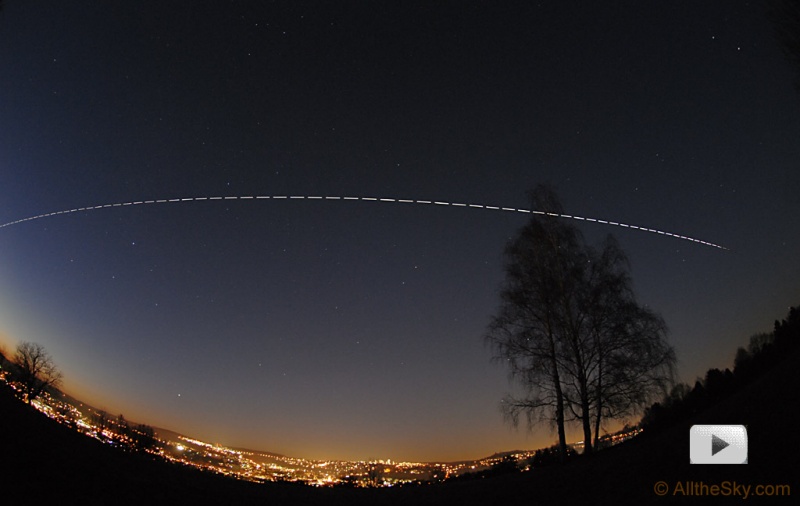
Orbiting 400,000 kilometers above the Earth, the Moon slid into Earth's shadow to begin last week's total lunar eclipse. Of course the International Space Station (ISS) slides into Earth's shadow every 90 minutes, the time it takes it to complete one orbit at an altitude of about 400 kilometers. Recorded near sunset on February 7, looking toward the north, this composite of 70 exposures shows the trail of the ISS (with gaps between exposures) as it moved left to right over the city of Tübingen in southern Germany. Beginning in sunlight on the left, the ISS vanishes as it enters Earth's shadow at the far right, above the northeastern horizon. As seen from Tübingen, the passage took about 4 minutes. Clicking on the image will download a time-lapse animation (mpg file) based on the individual exposures that includes a plane flying along the horizon.