The Moon
The Moon is Earth’s only natural satellite—a rocky, cratered body about one‑quarter the diameter of Earth, orbiting at an average distance of approximately 384,400 km. It influences tides, stabilizes Earth’s axial tilt, and was formed about 4.5 billion years ago following a collision between Earth and a Mars-sized object.
Source: science.nasa.gov
APODs including "The Moon"
June's Young Crescent Moon
07/06/2008
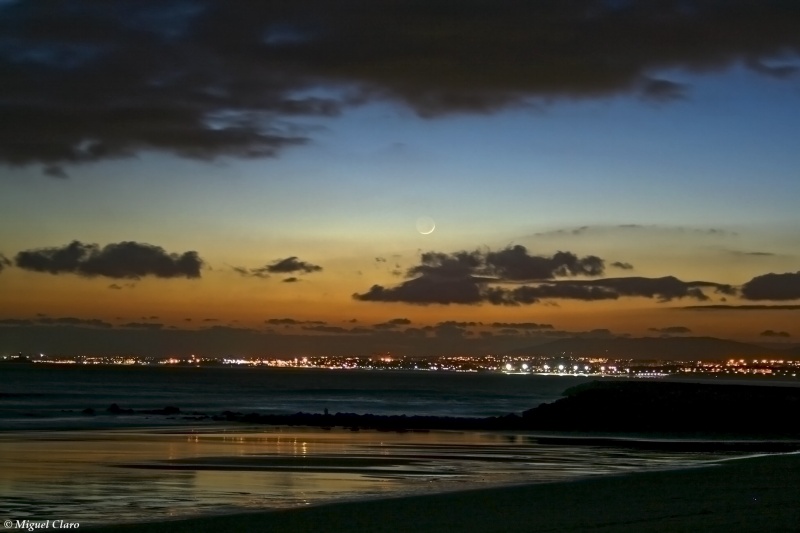
Serene skyviews were enjoyed across planet Earth earlier this week with a young crescent Moon low in the western sky just after sunset. Recorded on June 4, this colorful example includes a quiet beach in the foreground with the city lights of Lisbon, Portugal, and the Sintra Mountains along the horizon. Posing between cloud banks, the Moon's slender, sunlit arc represents only about 1 percent of the full lunar disc. The rest of the Moon's nearside is faintly visible though, illuminated by Earthshine. A waxing crescent Moon should also create some lovely western skies at dusk this weekend. The bright star in the sky near tonight's (Saturday's) Moon will actually be the planet Mars. On Sunday the Moon will move closer to a pair of celestial beacons, bright star Regulus and Saturn.