The Moon
The Moon is Earth’s only natural satellite—a rocky, cratered body about one‑quarter the diameter of Earth, orbiting at an average distance of approximately 384,400 km. It influences tides, stabilizes Earth’s axial tilt, and was formed about 4.5 billion years ago following a collision between Earth and a Mars-sized object.
Source: science.nasa.gov
APODs including "The Moon"
Planets over Perth
12/09/2008
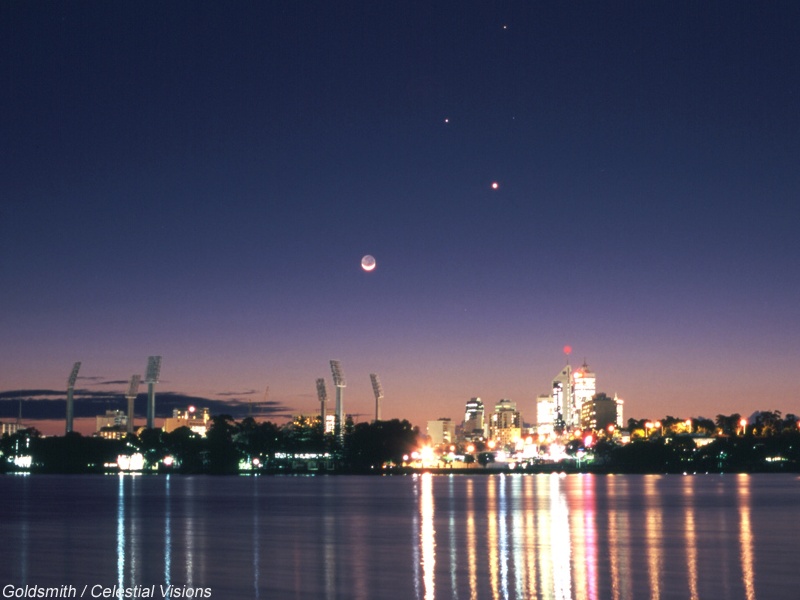
A bright trio of terrestrial planets was joined by a young Moon on September 1st, in planet Earth's early evening skies. In this view of the celestial gathering from Perth, Western Australia, the Moon's sunlit crescent is nearly horizontal at Perth's southern latitude of about 32 degrees. Venus, then Mercury, and finally Mars shine above colorful city lights on the far shore of the Swan River. The six unlit towers on the left surround a large cricket stadium. For now, the planetary trio still lingers low in the west just after sunset. But in the coming days Venus will move farther from the Sun, climbing higher after sunset, while Mercury and Mars will steadily sink into the glare along the western horizon. Note: Free Astronomy Course Taught Online by an APOD Editor