The Moon
The Moon is Earth’s only natural satellite—a rocky, cratered body about one‑quarter the diameter of Earth, orbiting at an average distance of approximately 384,400 km. It influences tides, stabilizes Earth’s axial tilt, and was formed about 4.5 billion years ago following a collision between Earth and a Mars-sized object.
Source: science.nasa.gov
APODs including "The Moon"
Moon Rays over Byurakan Observatory
26/09/2008
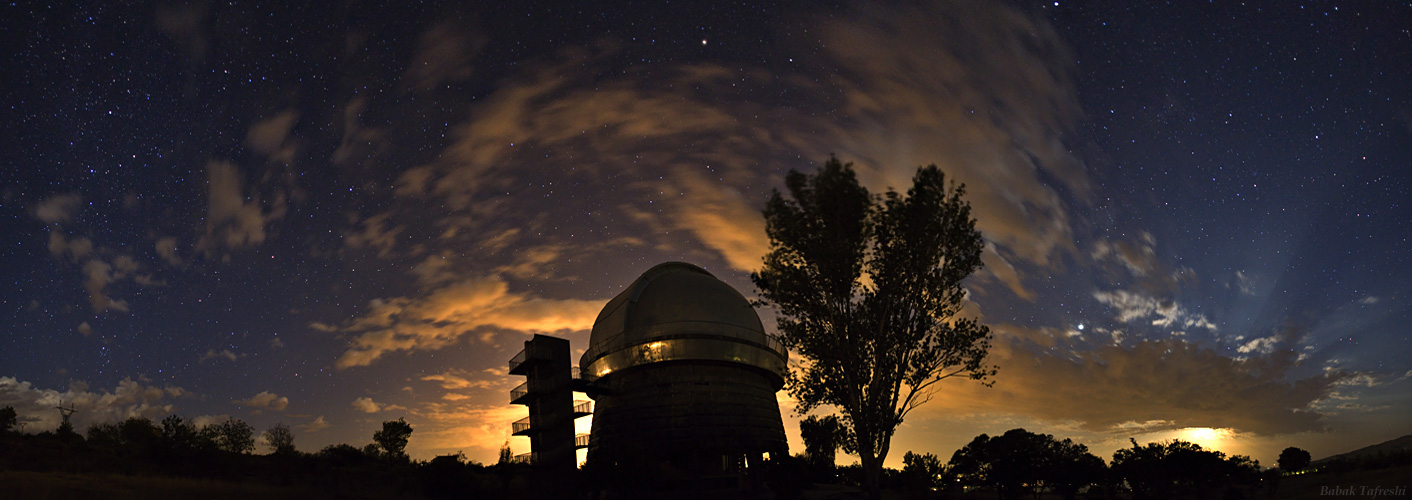
On September 7th, the first quarter Moon and passing clouds contributed to a dramatic night sky over the Byurakan Astrophysical Observatory. This panoramic view begins at the left looking toward the eastern horizon and the rising stars of the constellation Perseus. Sweeping your gaze to the right (south), you'll find the large observatory dome, housing a 2.6 meter diameter telescope, backlit by lights from nearby Yerevan, capital city of Armenia. Fittingly poised above the observatory dome is the bright, giant star Enif in the high-flying constellation Pegasus. Farther to the right, the brightest celestial beacon just above the clouds is our Solar System's ruling gas giant Jupiter. At the far right, the Moon is nearly hidden by an approaching cloudbank, but the clouds themselves actually cast shadows in the bright moonlight, creating the effect of Moon rays across the evening sky.