The Moon
The Moon is Earth’s only natural satellite—a rocky, cratered body about one‑quarter the diameter of Earth, orbiting at an average distance of approximately 384,400 km. It influences tides, stabilizes Earth’s axial tilt, and was formed about 4.5 billion years ago following a collision between Earth and a Mars-sized object.
Source: science.nasa.gov
APODs including "The Moon"
Lunar Diamond
06/12/2008
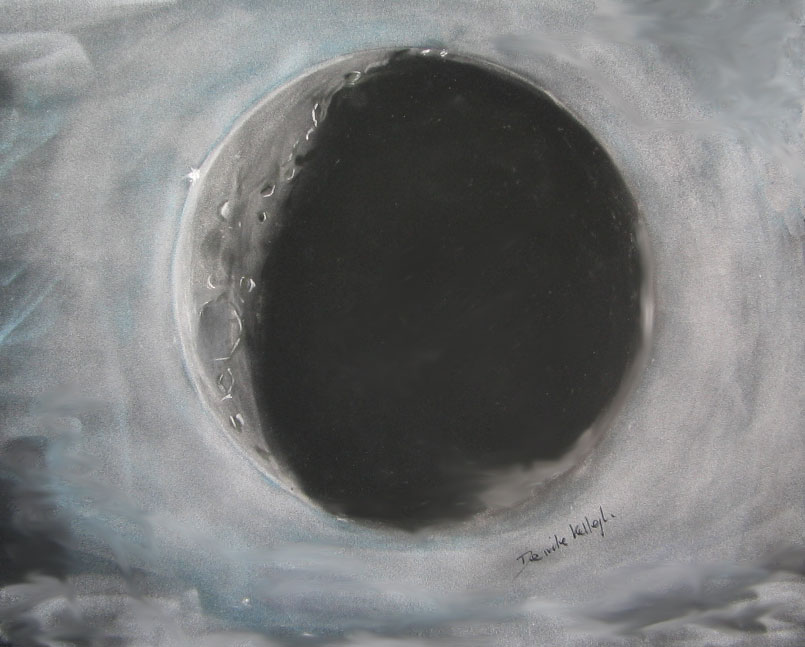
Cameras around the globe pointed skyward this week to capture the spectacular conjunction of a crescent Moon and bright planets Venus and Jupiter. But astronomer-artist Deirdre Kelleghan recorded her observations in sketches of the celestial event. From Greystones, County Wicklow, Ireland, her small telescope allowed her to follow the accompanying lunar occultation as a brilliant Venus disappeared behind the Moon's dark edge, then reappeared along the bright lunar limb. Her lovely drawing of the reemergence of Venus was made with pastels and conte crayons on A3 size paper under very cold conditions. She remarks, "The view as Venus once again sparkled like a diamond stuck on the moon was stunning."