The Moon
The Moon is Earth’s only natural satellite—a rocky, cratered body about one‑quarter the diameter of Earth, orbiting at an average distance of approximately 384,400 km. It influences tides, stabilizes Earth’s axial tilt, and was formed about 4.5 billion years ago following a collision between Earth and a Mars-sized object.
Source: science.nasa.gov
APODs including "The Moon"
Moon, Mercury, Jupiter, Mars
26/02/2009
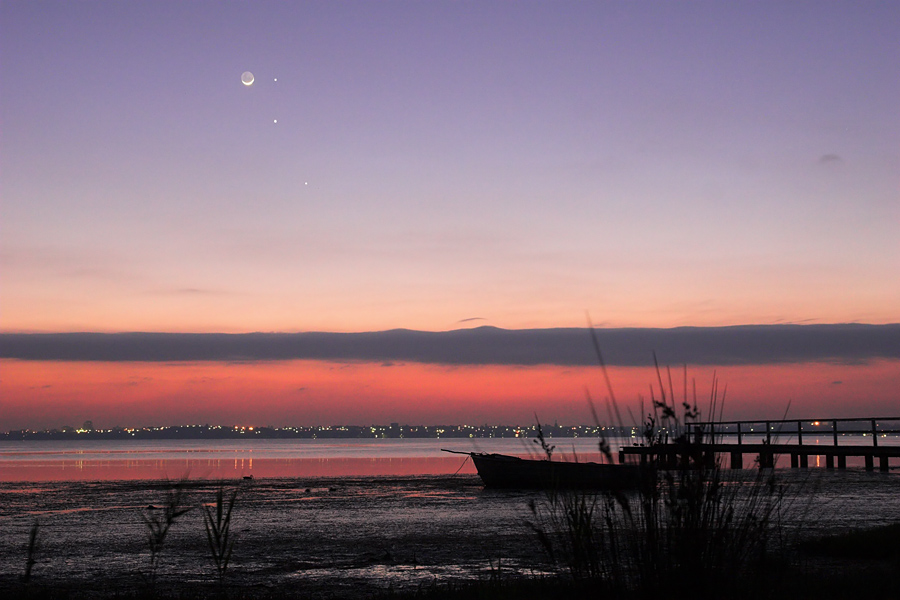
When the Moon rose in predawn skies on February 23rd, it sported a sunlit crescent. It also offered early morning risers a tantalizing view of earthshine, the dark portion of the lunar disk illuminated by sunlight reflected from the Earth. Of course, on that morning a remarkable conjunction with three wandering planets added an impressive touch to the celestial scene. Recorded just before sunrise, this serene skyview looks east toward a glowing horizon across Tuggerah Lake on the Central Coast of New South Wales, Australia. Along with the waning crescent Moon, the picture captures (top to bottom) bright Mercury, Jupiter, and Mars.