The Moon
The Moon is Earth’s only natural satellite—a rocky, cratered body about one‑quarter the diameter of Earth, orbiting at an average distance of approximately 384,400 km. It influences tides, stabilizes Earth’s axial tilt, and was formed about 4.5 billion years ago following a collision between Earth and a Mars-sized object.
Source: science.nasa.gov
APODs including "The Moon"
Crescent Moon and Venus
06/03/2009
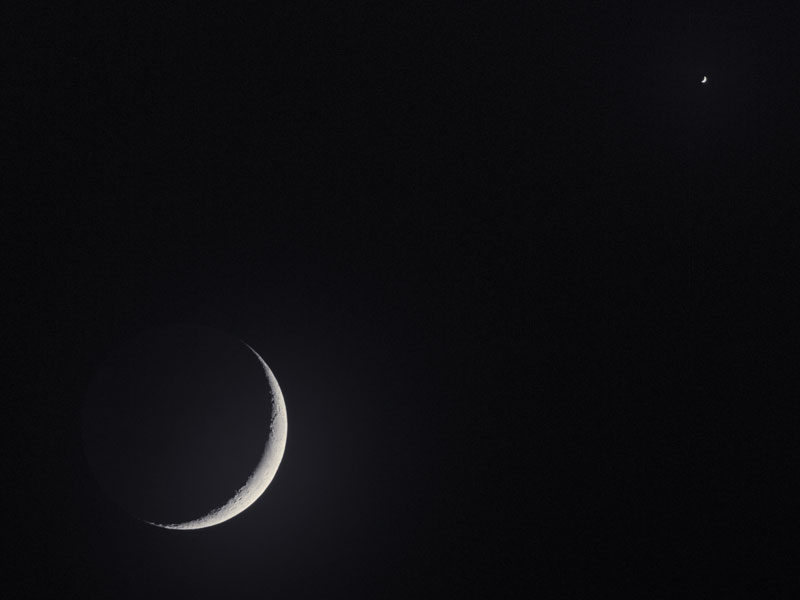
Last Friday, the Moon and Venus shared the early evening sky in a beautiful conjunction. Separated by only about 2 degrees, they also were both in a crescent phase. Just like our Moon, Venus can appear as a full disk or a thin crescent. Frequently the brightest object in the post-sunset or pre-sunrise sky, Venus is so small that it usually requires binoculars or a small telescope to clearly see its phase. This telescopic image of Friday's conjunction shows off the similar crescent phases, with the tiny crescent Venus at the upper right.