The Moon
The Moon is Earth’s only natural satellite—a rocky, cratered body about one‑quarter the diameter of Earth, orbiting at an average distance of approximately 384,400 km. It influences tides, stabilizes Earth’s axial tilt, and was formed about 4.5 billion years ago following a collision between Earth and a Mars-sized object.
Source: science.nasa.gov
APODs including "The Moon"
M39: Open Cluster in Cygnus
12/04/2009
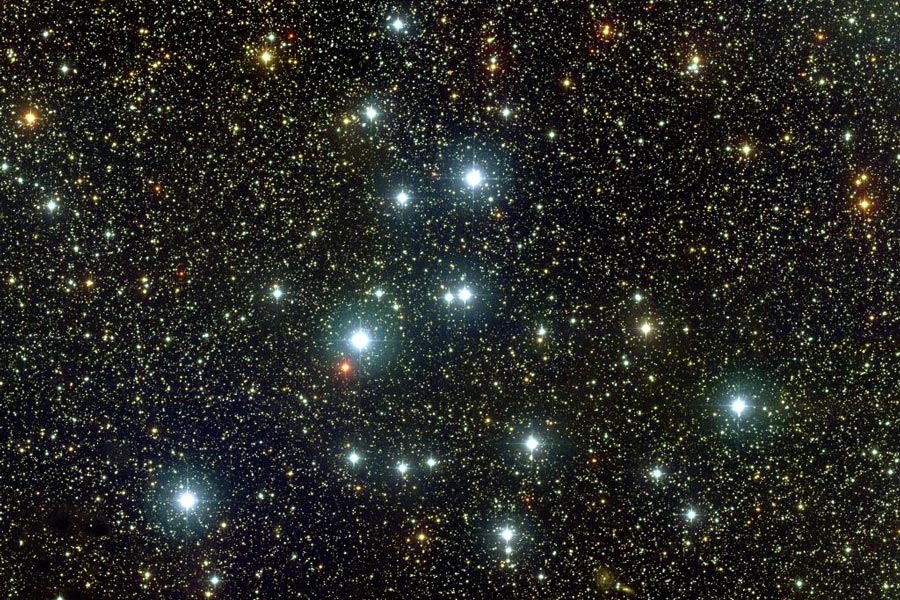
Lying just at the limit of human perception is a picturesque starfield containing one of the larger open clusters on the northern sky. Spanning an angle larger than the Moon, M39's relatively few stars lie only about 800 light years distant toward the constellation of Cygnus. The above picture of M39 is a mosaic of 33 images taken by the WIYN telescope on Kitt Peak in Arizona, USA. The stars in M39 are all about 300 million years old, much younger than the 5,000 million years of our Sun. Open clusters, also called galactic clusters, contain fewer and younger stars than globular clusters. Also unlike globular clusters, open clusters are generally confined to the plane of our Galaxy.